Greater Region
Longwy presses Luxembourg to help fund services strained by commuters
The French border town, where about 43% of workers cross into the Grand Duchy, wants Luxembourg to help pay for its schools and transport — reviving a long-stalled fight over cross-border tax-sharing.
By Tom Schmit · · 4 min read
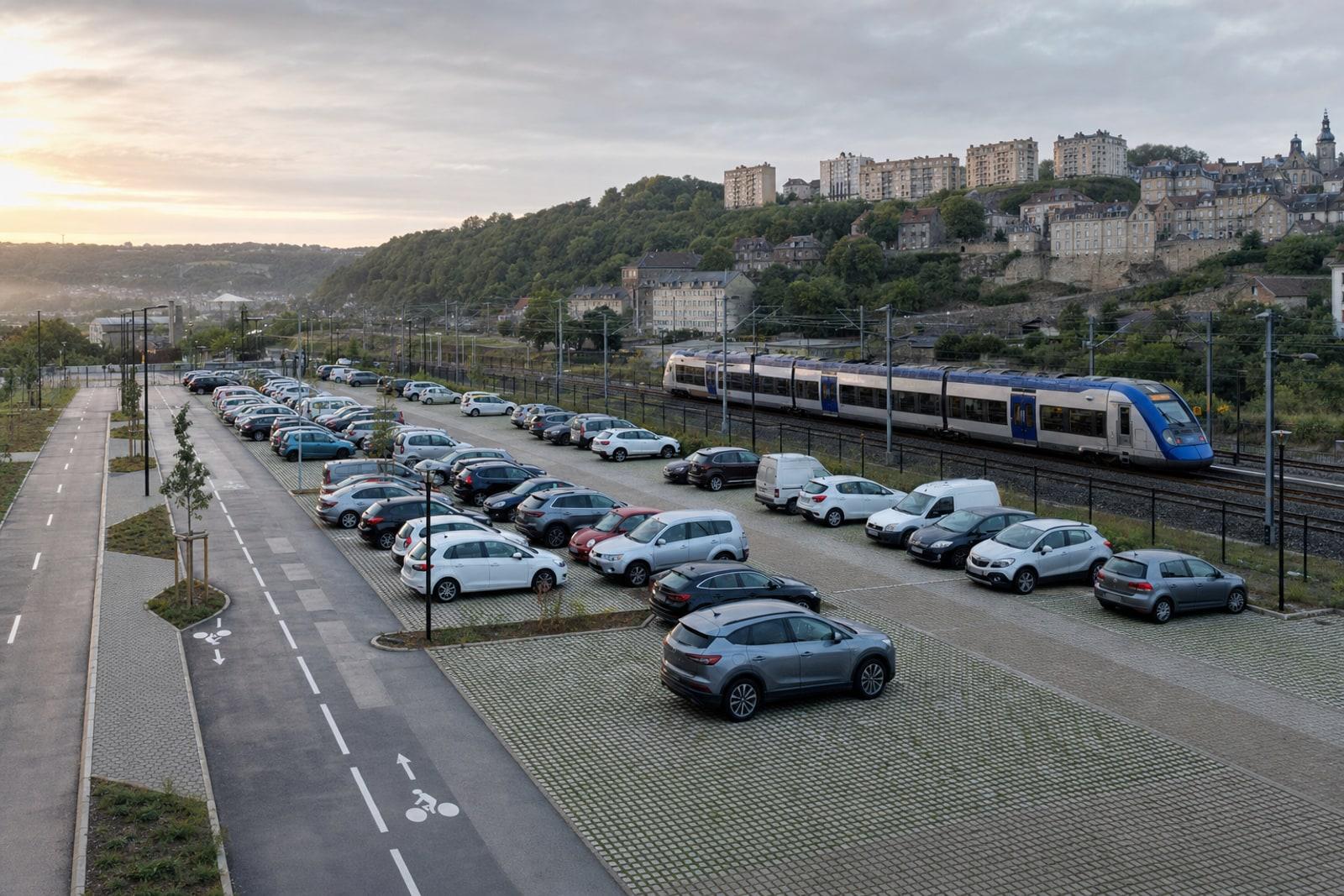
The French border town of Longwy is demanding that Luxembourg help pay for the schools, childcare and transport its residents lean on — but where many of them no longer pay their taxes. With roughly 43% of the town's working population employed across the border in the Grand Duchy, mayor Vincent Hamen says the arrangement has become unsustainable for a municipality of about 15,600 people whose budget does not grow with the wages its residents earn abroad.
The complaint is not new, but it has hardened into a formal political demand. On 27 November 2025 the council of the Meurthe-et-Moselle department, where Hamen is vice-president for cross-border affairs, adopted a manifesto calling on the French state and Luxembourg to deliver "fairer" compensation for border territories, a binding negotiating calendar, and the appointment of a dedicated French interministerial delegate to deal with Luxembourg as a single, empowered interlocutor.
A town reshaped by the border
Longwy sits in the Pays-Haut, the northern tip of Lorraine wedged against both Luxembourg and Belgium, and its economy has been remade by the Grand Duchy's pull. Across France, some 126,600 residents commuted to work in Luxembourg in 2025, according to figures compiled from IGSS and STATEC data — up about 3,245 on the year and making French residents the largest single group, around 55%, of Luxembourg's 233,260 cross-border workers.
That gravity strains local services in ways that do not show up as growth. Hamen points to childcare and after-school programmes that have to expand even as enrolment shifts: for the 2025 school year the town recorded 75 fewer pupils overall but a roughly 30% jump in demand for after-school services, the kind of squeeze a town cannot simply build its way out of. The income tax that would normally help pay for it is levied in Luxembourg, where the commuters work, not in France, where they sleep, raise children and use the roads.
What Longwy is asking for
Hamen's central demand is direct financial compensation from Luxembourg for the public services its commuters rely on, handled at government level rather than left to a town hall to fight for. He has framed earlier Luxembourg gestures — such as co-funding a commuter car park — as welcome but far short of what is needed.
We must be able to develop our services and go further than simply financing a car park.
The manifesto goes further, explicitly invoking the Franco-Swiss precedent. "There is an urgent need to respond to our citizens' expectations," Hamen said, calling on the French state and demanding "fair financial compensation, on the model of the agreements between France and the canton of Geneva in Switzerland." Border officials estimate that, on a Geneva-style formula, Longwy alone could receive between €2.8 million and €3.6 million a year. Their wider calculations put the total France might claim at €192 million to €247 million annually, with Thionville and Metz among the largest potential beneficiaries.
Luxembourg's counter-offer: projects, not cheques
Luxembourg has consistently resisted permanent retrocession, arguing it already pays its way through targeted investment rather than open-ended transfers. The finance ministry, responding to earlier cross-border demands, said the Grand Duchy "already contributes to financing, beyond its borders, infrastructure that is useful and beneficial to the daily lives of cross-border workers."
Officials point to a bilateral transport package: €120 million agreed in 2018, topped up by a further €110 million in October 2021 for rail services, alongside cooperation deals spanning health, security and emergency response. The most visible recent example is in Longwy itself. On 1 August 2025, Luxembourg's mobility minister Yuriko Backes inaugurated a new 633-space park-and-ride, built under the 2018 Paris agreement and its 2021 amendment, with Luxembourg covering 50% of the €4.3 million cost — about €2.15 million. Backes called it a model of "exemplary cooperation between Luxembourg and France." For Hamen, it is also proof that the Grand Duchy can pay, and that the question is now scale and form, not principle.
A precedent next door — and one in Geneva
What sharpens French frustration is that Luxembourg already does, for one neighbour, almost exactly what Longwy is asking. Under a long-standing arrangement, it pays Belgian municipalities a compensation fund worth about €48 million in 2025, shared among 553 communes and set to climb toward roughly €72 million by 2031; the Belgian town of Arlon receives the largest slice, around €8.7 million. France, despite sending far more commuters, receives no equivalent.
The Geneva model the manifesto cites is older still: since 1973 the Swiss canton has handed back 3.5% of cross-border workers' gross payroll to neighbouring French departments, worth roughly €250 million a year. French analysts estimate Lorraine's border territories collectively forgo on the order of €1.7 billion annually in tax that flows to Luxembourg instead.
With the joint pressure now extending to German border officials and the council president Chaynesse Khirouni, the dispute has widened from a single mayor's grievance into a Greater Region fault line. Some 50,000 additional frontaliers are projected by 2035. How the cross-border bill is split — projects, payments, or a delegate empowered to negotiate both — remains, for now, unresolved.
Frequently asked
- What is Longwy asking Luxembourg for?
- Longwy's mayor, Vincent Hamen, wants direct financial compensation from Luxembourg to help fund the schools, childcare, transport and infrastructure used by residents who commute to the Grand Duchy, plus a French interministerial delegate to negotiate the issue government-to-government.
- Why don't French border towns get Luxembourg tax money?
- Cross-border workers pay income tax where they work — in Luxembourg — not where they live in France. Unlike its arrangement with Belgium, Luxembourg has no fiscal retrocession deal with France, so French border municipalities bear service costs without the corresponding tax revenue.
- How much does Luxembourg pay Belgium by comparison?
- Luxembourg pays Belgian municipalities a compensation fund worth about €48 million in 2025, shared among 553 communes and rising toward roughly €72 million by 2031, with Arlon the largest recipient at around €8.7 million.
- What is Luxembourg's position?
- Luxembourg resists permanent retrocession, arguing it already co-finances cross-border infrastructure — €120 million in 2018 and €110 million in 2021 for rail, plus half the €4.3 million Longwy park-and-ride — and prefers funding concrete projects over open-ended payments.
Sources(9)
- 1Frontaliers: Longwy réclame au Luxembourg un financement de ses services publicsL'essentiel · lessentiel.lu
- 2Des élus frontaliers demandent des millions de rétrocessionPaperjam · paperjam.lu
- 3France-Luxembourg : un plaidoyer pour en finir avec les inégalités transfrontalièresMission Opérationnelle Transfrontalière (MOT) · espaces-transfrontaliers.org
- 4Inauguration du nouveau P+R de LongwyLe gouvernement luxembourgeois · gouvernement.lu
- 5Rétrocession fiscale: L'urgence d'un chantier en fricheForum.lu · forum.lu
- 6Ils réclament des millions au Luxembourg, le ministère leur répondL'essentiel · lessentiel.lu
- 748M€ du Luxembourg pour 553 communes belgesPaperjam · paperjam.lu
- 8126 600 travailleurs frontaliers du Luxembourg résidant en France en 2025AGURAM (Observatoire territorial transfrontalier) · aguram.org
- 93 245 frontaliers français de plus et 287 Allemands de moins au LuxembourgL'essentiel · lessentiel.lu
Related by topic