Space sector
Mission Space builds out a space-weather constellation as Luxembourg backs its space economy
The Israeli-founded, Luxembourg-listed start-up has put its first Zohar storm-warning sensor in orbit and plans a 24-node constellation — a concrete gauge of the Grand Duchy's space strategy.
By Marc Weber · · 4 min read
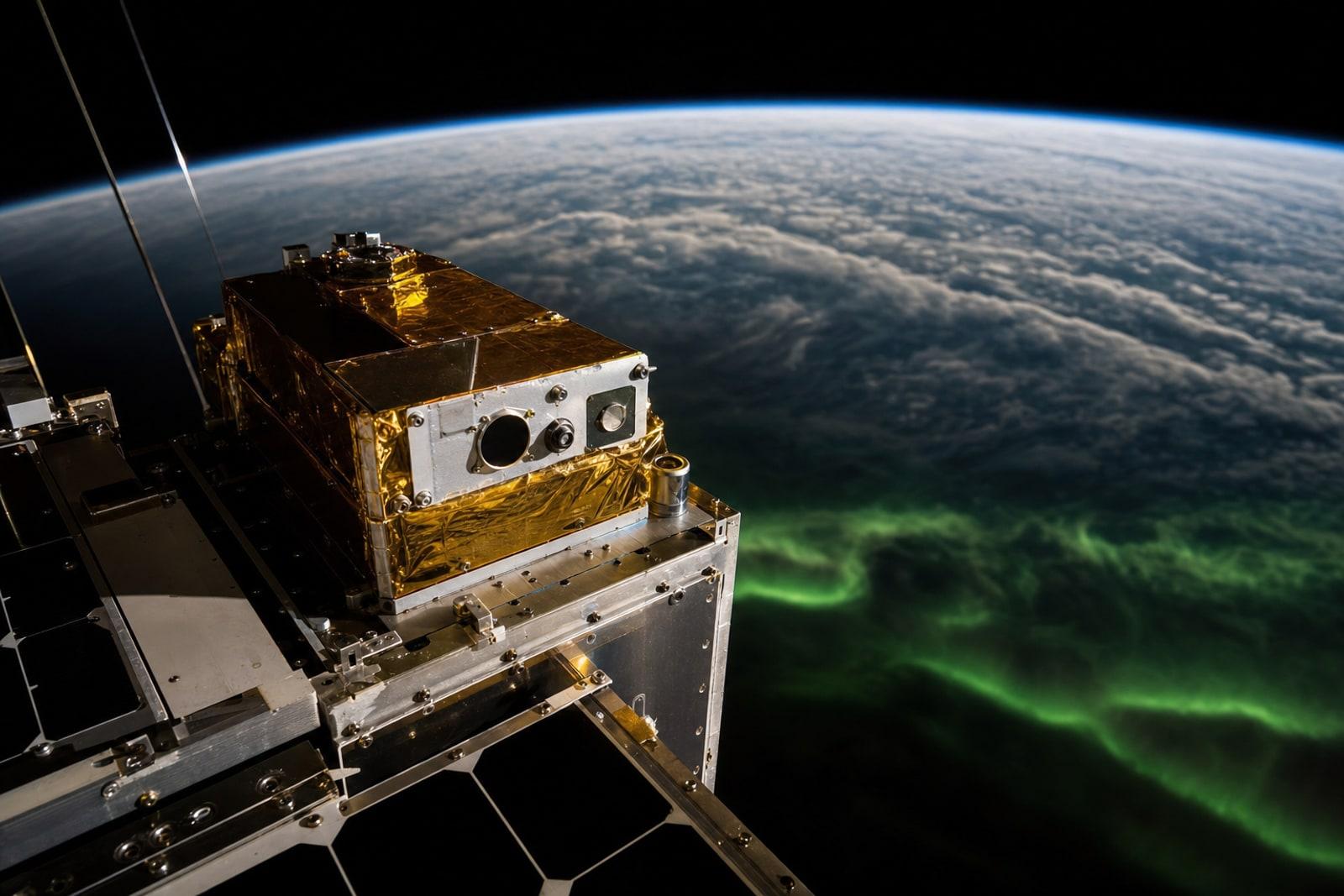
For nearly a decade Luxembourg has spent public money trying to turn a country of about 670,000 people into a fixture of the global space business. A small, Israeli-founded start-up now offers a concrete way to gauge whether that bet is working. Mission Space, a space-weather forecasting firm listed in the Luxembourg Space Agency's official directory, put its first storm-warning sensor into orbit in 2025 and is building toward a constellation of roughly two dozen.
The company sells neither rockets nor moon landers, but warning time. Space weather — the bursts of radiation and charged particles thrown out by solar flares and coronal mass ejections — can scramble satellites, degrade GPS, stress power grids and expose aircrew and, eventually, astronauts to dangerous doses. Mission Space says its sensors and machine-learning models aim to give customers up to four days' notice of severe solar storms, with forecasts pinned to specific locations rather than the whole planet.
“Our goal is to give customers actionable forecasts,” chief executive and co-founder Alex Pospekhov told Refresh Miami. “For instance, satellite operators can adjust orbits, and farmers can plan around potential weather-related disruptions.”
From a rideshare launch to a constellation
Mission Space's first sensor, named Zohar, launched on SpaceX's Transporter-13 rideshare mission from Vandenberg Space Force Base in California in March 2025, according to SpaceNews and trade-press accounts of the flight. The instrument — described by the company as a proprietary package combining a spectrometer and a Cherenkov detector capable of around 1,000 measurements a second — is hosted and operated in low Earth orbit by DPhi Space.
That first payload is a down-payment on a larger design. The company intends to deploy about 24 Zohar sensors across two orbital planes, an arrangement meant to ensure that one node passes through the polar cusp — a region of the magnetosphere especially sensitive to solar activity — roughly every hour. Mission Space has said it aims to have the full constellation operating by 2027.
The ambition is deliberately framed beyond Earth orbit. Radiation is the central hazard for any sustained human presence on the Moon or a journey to Mars, and Pospekhov has cast his company as a supplier of that safety layer. “If we're going to Mars, understanding radiation is crucial,” he told Refresh Miami. “Mission Space will be the company that helps astronauts navigate these risks.”
Why Luxembourg
Mission Space's roots are international — its founders are Israeli and its commercial base sits in the United States — yet it has anchored its forecasting ambitions in the Grand Duchy. It appears in the Luxembourg Space Agency's directory and runs a three-year research partnership with the University of Luxembourg's Interdisciplinary Centre for Security, Reliability and Trust (SnT), led by Prof. Andreas Hein and Dr. Maxime Cordy, to build the machine-learning models behind its forecasts.
That is exactly the kind of catch Luxembourg's strategy was designed to make. The country has been deliberate about space for four decades:
- It launched its space adventure in 1985 with the satellite operator SES, now a world leader in satellite communications, and joined the European Space Agency in 2005.
- In July 2017 it became the first European country to pass a law on the exploration and use of space resources, the legal core of its SpaceResources.lu initiative, backed by a commitment of around €200 million.
- It created the Luxembourg Space Agency in 2018 and runs the LuxImpulse national programme to co-fund company projects with ESA.
- It signed a memorandum of understanding on lunar cooperation with NASA in 2019 and was an original signatory of the Artemis Accords in 2020.
The founders see their work as a fit with that agenda.
Developing this technology will position Luxembourg as a global hub for space weather studies.
That line, from Pospekhov and co-founder Alexey Shirobokov as reported by Paperjam, captures the bargain on offer: a small state lends legal certainty, co-funding and research muscle, and in return claims a seat at a table — from low Earth orbit out toward the cislunar economy — far larger than its size would suggest.
A measure of the bet
By the Luxembourg Space Agency's own count, the space sector now accounts for about 2% of national GDP, some 70 companies and roughly 1,400 jobs, and the government has set a goal of doubling that contribution to around 4% by 2027. Concrete operating companies, rather than announcements, are how that target gets met — and Mission Space is one of the more tangible tests.
The caveats are real. Only one Zohar sensor is confirmed on orbit so far; the full 24-node constellation remains a plan. The company's disclosed funding is modest by space-industry standards — a pre-seed of about $1.1 million and a partly raised seed round, with aggregate funding reported at roughly $2.5 million — and its footprint is genuinely distributed rather than purely Luxembourgish. Whether it scales into a durable forecasting utility or remains a promising early-stage venture is still an open question.
But that is precisely why it matters to readers weighing the Grand Duchy's space gamble. Luxembourg's wager has always been that a small country can buy relevance in a frontier industry by being early, legally clear and willing to spend. Mission Space is one of the places where that wager is being measured — not in a glossy strategy document, but in hardware already circling the Earth.
Frequently asked
- What does Mission Space do?
- It is a space-weather forecasting start-up. Using a proprietary sensor called Zohar (a spectrometer and Cherenkov detector) plus machine-learning models, it aims to warn satellite operators, power grids, aviation and others of solar storms up to about four days in advance.
- Has NASA selected Mission Space for a lunar project?
- No such NASA selection or contract could be verified in any reputable source as of June 2026. Mission Space publicly frames its technology toward future lunar and Mars missions, and Luxembourg has cooperated with NASA at state level (a 2019 memorandum of understanding and the Artemis Accords), but that is national-level cooperation, not a NASA award to this company.
- How is Mission Space connected to Luxembourg?
- It is listed in the Luxembourg Space Agency's directory and runs a research partnership with the University of Luxembourg's SnT centre, even though its founders are Israeli and it also has a US commercial base.
- Why does this matter for Luxembourg?
- Luxembourg has spent nearly a decade and substantial public money building a space economy. A working space-weather company is a concrete measure of whether that strategy yields real businesses and technology rather than just announcements.
Sources(15)
- 1Mission Space to launch first sensors for space-weather constellationSpaceNews · spacenews.com
- 2Mission Space Set To Launch First Sensors For Space Weather Constellation Aboard SpaceX Transporter-13TLP Network · tlpnetwork.com
- 3Zohar rides with SpaceX to enhance real time space weather coverageTerra Daily / Space Daily · terradaily.com
- 4SpaceX Launches 74 Payloads on the Transporter-13 Rideshare MissionVia Satellite · satellitetoday.com
- 5Mission Space to launch satellite network in 2025Paperjam · paperjam.lu
- 6Developing space weather forecasting in LuxembourgPaperjam · paperjam.lu
- 7From Miami to Mars, Mission Space is safeguarding life on Earth and beyondRefresh Miami · refreshmiami.com
- 8Mission Space Develops Zohar Detector for Real-Time Orbital Radiation MonitoringSatNow · satnow.com
- 9Mission Space — Space DirectoryLuxembourg Space Agency · space-agency.public.lu
- 10Mission Space (Luxembourg) Funding profileSpace-Startups.org · space-startups.org
- 11Luxembourg Space AgencyWikipedia · en.wikipedia.org
- 12Luxembourg: Law on Use of Resources in Space AdoptedLibrary of Congress (Global Legal Monitor) · loc.gov
- 13Luxembourg adopts space resources lawSpaceNews · spacenews.com
- 14Law of July 20th 2017 on the exploration and use of space resourcesLuxembourg Space Agency · space-agency.public.lu
- 15ispace-EUROPE Secures First-Ever Mission Authorization Under Luxembourg's Space Resources LawLuxembourg Trade & Invest · luxembourgtradeandinvest.com
Related by topic