Disaster
Venezuela earthquake kills more than 900 as Luxembourg sends emergency team
Twin quakes of magnitude 7.2 and 7.5 flattened buildings across Caracas and La Guaira on 24 June. Luxembourg has deployed a rescue team and its emergency.lu satellite system to the disaster zone.
By Léa Hoffmann · · 4 min read
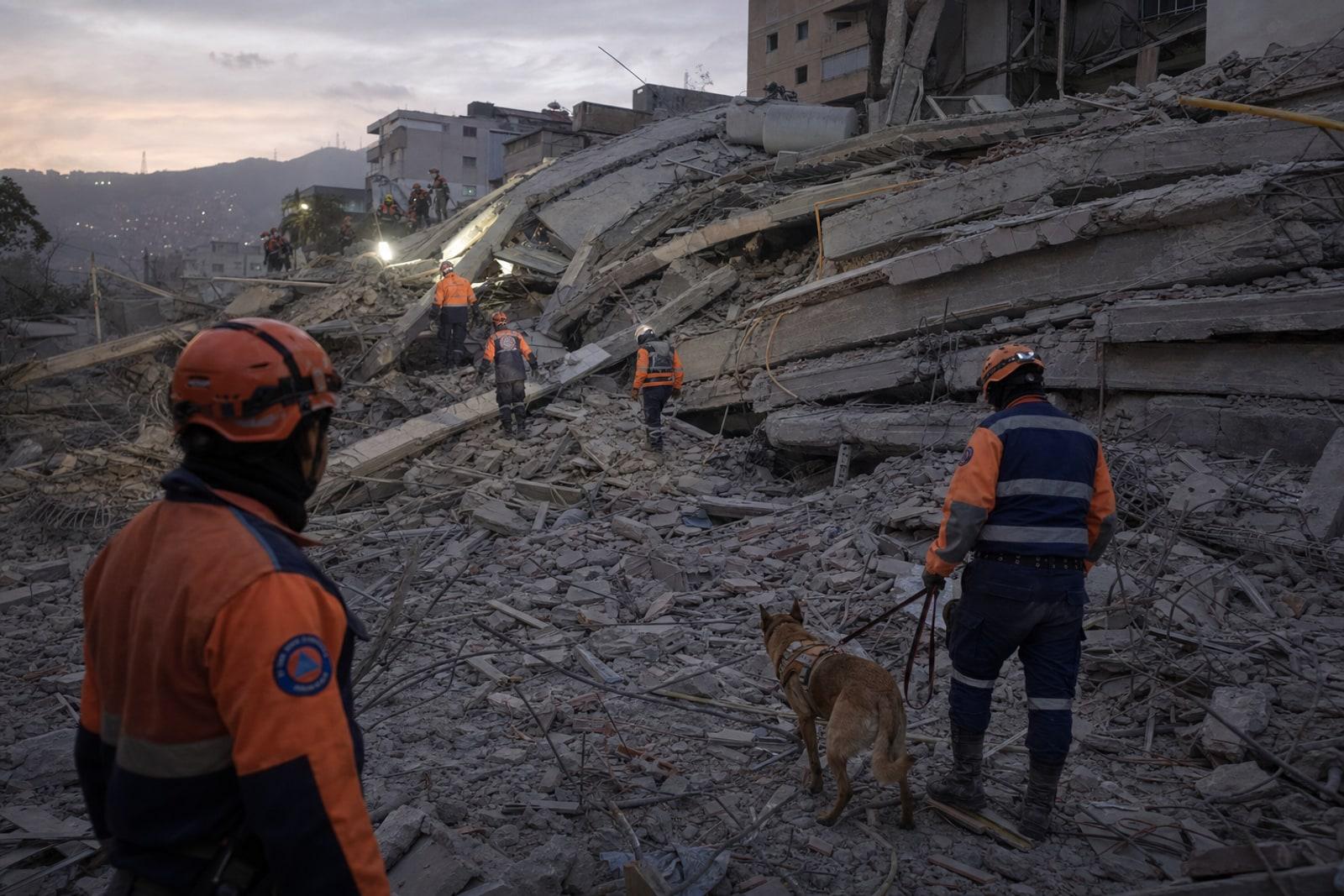
More than 900 people have been confirmed dead in Venezuela after two powerful earthquakes struck the country's densely populated north-central coast within seconds of each other, collapsing apartment towers in the capital, Caracas, and triggering one of the largest international rescue operations in the region's recent history. Luxembourg is among the European states now sending help, deploying a specialist rescue team and a mobile satellite communications system to the disaster zone.
The first quake, a magnitude 7.2 tremor, hit at 18:04 local time on 24 June, according to the United States Geological Survey (USGS). It was followed roughly 39 seconds later by a magnitude 7.5 mainshock. Both were shallow ruptures on the San Sebastián fault system, with the epicentre near San Felipe in Yaracuy state, west of the capital. Seismologists say it is the most powerful earthquake recorded in Venezuela since 1900.
A rising death toll
Casualty figures climbed sharply through the week. Officials reported at least 188 deaths on 25 June; by 26 June, the president of Venezuela's National Assembly, Jorge Rodríguez, said more than 920 people had been killed and around 3,000 wounded, with some tallies putting the number of injured above 4,500. Tens of thousands of people were reported missing in early estimates, though the authorities have given lower figures, and rescue teams said hundreds remained trapped beneath collapsed structures nearly three days after the quakes. The United Nations estimated that close to seven million Venezuelans had been affected.
The destruction was concentrated in Caracas and the coastal state of La Guaira. Several high-rise buildings collapsed in the capital's Altamira and Los Palos Grandes districts. Venezuela's interior minister, Diosdado Cabello, said more than 100 buildings had collapsed in La Guaira alone and that roughly 70,000 families had been affected. The country's main gateway, Simón Bolívar International Airport, was heavily damaged, the Caracas Metro was suspended and schools were closed. Acting President Delcy Rodríguez declared a state of emergency and designated La Guaira a disaster zone.
"To the Venezuelan people, to those whose loved ones are under the rubble, know that we are determined that help gets to you." That message came from Tom Fletcher, the United Nations' humanitarian chief, as UN agencies began deploying aid and rescue specialists. Recovery work has been repeatedly interrupted by aftershocks, including a magnitude 4.9 tremor on 26 June that briefly halted operations in some areas.
An international rescue effort
Search-and-rescue contingents converged on Venezuela from across the Americas and Europe within 48 hours. Teams arrived from Chile, Colombia, Ecuador, Mexico, Brazil and the United States, where the Federal Emergency Management Agency dispatched urban search-and-rescue task forces. France sent 85 rescuers, while Spain, Switzerland and the United Kingdom contributed specialists and sniffer-dog teams.
Much of the European effort is being channelled through the EU Civil Protection Mechanism, which Venezuela's neighbours and the bloc activated to coordinate assistance. According to the European Commission, eight member states — Czechia, Spain, Italy, France, Luxembourg, Germany, Portugal and the Netherlands — are supplying personnel and equipment, with more than 520 responders mobilised. The Commission said the EU had already allocated €52 million in 2026 to address Venezuela's humanitarian needs.
European Commission President Ursula von der Leyen said the bloc stood ready to help: "We stand with the people of Venezuela at this time of great tragedy and catastrophe."
Luxembourg's contribution
On 26 June, Luxembourg announced its own deployment. Deputy Prime Minister Xavier Bettel, who holds the development cooperation and humanitarian affairs portfolio, and Home Affairs Minister Léon Gloden authorised sending a two-member team from the Humanitarian Intervention Team (HIT) of the Grand Ducal Fire and Rescue Corps (CGDIS), together with the country's emergency.lu satellite communication system.
The emergency.lu platform — a Luxembourg public-private initiative designed for disaster zones where conventional networks have failed — is intended to give aid organisations a working communications backbone. In a statement, the government said the team's task was clear:
Their mission will be to restore telecommunications services in the affected region, enabling humanitarian organisations to carry out their work.
Luxembourg said three further HIT experts would reinforce the European Commission's coordination team on the ground. The deployments, announced jointly by the Directorate for Development Cooperation and Humanitarian Affairs, the Ministry for Home Affairs and the Ministry of Foreign and European Affairs, are expected to last about two weeks initially and are co-financed 75% by the European Union and 25% by Luxembourg.
What comes next
With the so-called golden window for finding survivors closing, the focus is shifting from rescue toward relief for the hundreds of thousands left homeless or displaced. Restoring communications, power and shelter in the worst-hit coastal areas will be a central challenge in the days ahead — and the niche role Luxembourg has taken on, keeping aid agencies connected, is likely to matter well beyond the initial emergency. The full human cost, officials caution, will not be known until search teams have reached every collapsed building.
Frequently asked
- How strong was the Venezuela earthquake and where did it hit?
- Two quakes struck on 24 June 2026 about 39 seconds apart: a magnitude 7.2 foreshock and a magnitude 7.5 mainshock, according to the USGS. The epicentre was near San Felipe in Yaracuy state, with the heaviest damage in Caracas and La Guaira.
- How many people died in the Venezuela earthquakes?
- By 26 June 2026, National Assembly President Jorge Rodríguez reported more than 920 deaths and around 3,000 wounded. The toll rose steadily through the week, and rescuers said hundreds of people remained trapped under collapsed buildings.
- What is Luxembourg doing to help Venezuela?
- Luxembourg deployed a two-member team from the Grand Ducal Fire and Rescue Corps (CGDIS) and its emergency.lu satellite communication system to restore telecoms in the disaster zone, plus three experts to support the EU coordination team. The mission is co-financed by the EU (75%) and Luxembourg (25%).
Sources(11)
- 12026 Venezuela earthquakesWikipedia · en.wikipedia.org
- 2World aids rescue effort as Venezuela quake death toll hits 920Al Jazeera · aljazeera.com
- 3June 26, 2026 — Over 900 killed in Venezuela earthquakesCNN · cnn.com
- 4Venezuela earthquakes live updates: Death toll rises to at least 920 as search nears 72 hoursABC News · abcnews.com
- 5Powerful twin earthquakes hammer Venezuela, killing at least 188NBC News · nbcnews.com
- 6Venezuela earthquakes LIVE: Death toll rises amid recovery and rescue effortsUN News · news.un.org
- 7Luxembourg Deploys Humanitarian Team to Earthquake-Hit VenezuelaChronicle.lu · chronicle.lu
- 8EU deploys emergency assistance to Venezuela following earthquakesEuropean Commission (DG ECHO) · civil-protection-humanitarian-aid.ec.europa.eu
- 9M 7.5 - 16 km SW of Morón, VenezuelaUSGS · earthquake.usgs.gov
- 10M 7.2 - 24 km ENE of San Felipe, VenezuelaUSGS · earthquake.usgs.gov
- 11Which countries have pledged aid to Venezuela after powerful earthquakes?Al Jazeera · aljazeera.com
Related by topic