Germany
German coalition agrees sweeping tax and pension package after months of deadlock
Chancellor Friedrich Merz's CDU/CSU-SPD coalition has unveiled a 34-measure 'Programme for Revival and Employment', pairing €10 billion in income tax relief with pension and labour reforms.
By Camille Reuter · · 4 min read
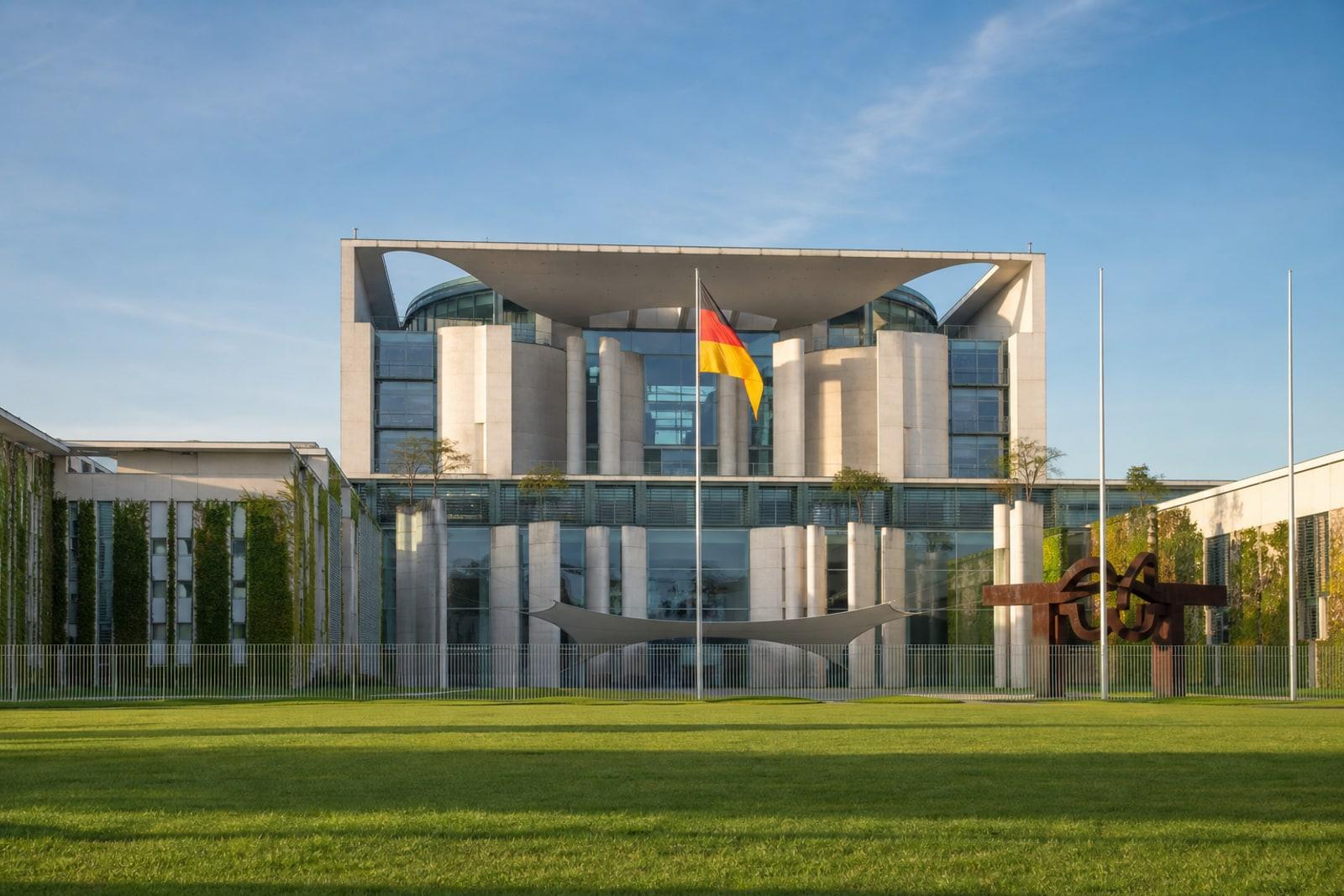
Germany's governing coalition has agreed a sweeping package of tax, pension and labour-market reforms, ending months of internal deadlock that had raised doubts about Chancellor Friedrich Merz's ability to govern Europe's largest economy. The 34-measure "Programme for Revival and Employment", struck in a late-night coalition committee session on Wednesday and presented on Thursday in the garden of the Federal Chancellery in Berlin, is aimed at reviving stalled growth — and at blunting the rise of the far-right Alternative for Germany (AfD) ahead of state elections in eastern Germany in September.
"We are doing everything we can to overcome our country's structural weakness when it comes to economic growth," Merz said as he presented the package, acknowledging that his government was "under pressure from many sides", according to AFP.
Tax relief for middle incomes, higher rates at the top
The centrepiece is roughly €10 billion a year in income tax relief targeted at lower and middle earners, taking effect on 1 January 2027, AFP and Reuters reported. Households earning up to €60,000 a year stand to gain about €600 annually, according to details reported by AFP and t-online.
The relief is to be financed by higher taxes at the top of the income scale. Under the agreement, a 45 per cent rate would apply from €250,000 of taxable income and a new 47 per cent top rate from €280,000 — up from the current 45 per cent "rich tax", according to t-online and Handelsblatt. Finance Minister and Vice-Chancellor Lars Klingbeil, leader of the Social Democrats, presented the shift as a matter of basic equity.
"The highest earners in this country will therefore take on a larger share of the tax burden. That is fair," Klingbeil said.
Pensions, sick notes and fixed-term contracts
Beyond taxation, the package reaches deep into Germany's welfare state and labour law:
- Pensions: the coalition committed to implementing all 33 recommendations of its government-appointed pension commission, with legislation to be passed by the Bundestag by the end of 2026. The proposals would link the retirement age to life expectancy after 2031, pushing it beyond the current legislated ceiling of 67 — by some estimates cited by Al Jazeera, towards 70 late in the century.
- Sick leave: the option of obtaining a sick note by telephone is scrapped, and a doctor's certificate becomes mandatory from the first day of illness, a bid to curb Germany's comparatively high absenteeism.
- Fixed-term work: employers will be able to use fixed-term contracts for up to 48 months, double the previous limit, with up to six extensions — a rule limited until the end of 2030.
- Bureaucracy: corporate reporting obligations are to be cut, federal ministries face an 8 per cent staffing reduction through digitisation, and the coalition agreed an action plan against benefit fraud, Reuters reported.
Most measures require approval by the Bundestag, and the tax reform also needs the consent of the Bundesrat, the chamber representing Germany's federal states. The government says it wants the key legislation completed by the end of the year.
Relief, and resistance
The deal was greeted in parts of the business and economics world as proof that the coalition — formed in 2025 by Merz's CDU/CSU and the SPD — can still deliver after months of public squabbling over pensions, social spending and labour rules. Marion Muehlberger, senior economist at Deutsche Bank, told AFP the announcement amounted to "one of Germany's biggest reform packages in decades" and demonstrated the government's ability to agree on important structural reforms.
Others were unimpressed. IG Metall, Germany's largest industrial union, called the labour measures "an attack on workers' rights", according to AFP. From the opposition, AfD parliamentary co-chairs Alice Weidel and Tino Chrupalla dismissed the programme as "a bitter disappointment" for citizens and the economy, saying in a statement that the coalition's rhetoric outran its results. The political stakes are plain: the coalition is trailing in the polls to the AfD in several eastern states that vote in September.
Why it matters for Luxembourg and the Greater Region
What Berlin decides rarely stays in Berlin — least of all for Luxembourg. Germany is the Grand Duchy's largest goods-export market, taking roughly a quarter of Luxembourg's exports (25.4 per cent in 2023, according to trade data compiled by Lloyds Bank's trade portal), and German firms are woven into the Greater Region's supply chains. A credible programme to restart German growth therefore matters directly to Luxembourg's industrial and logistics sectors, for which German demand is the single biggest external variable.
The labour measures resonate across the border too. Around 23 per cent of Luxembourg's more than 220,000 cross-border workers — roughly 50,000 people — commute from Germany, according to STATEC data reported by Chronicle.lu. Changes to German income tax from 2027, and a retirement age drifting upwards after 2031, will shape household finances and career calculations in Trier, Saarburg and the wider German borderlands from which many of those commuters come. And a Berlin government that can legislate again, rather than fight itself, restores a measure of predictability to the EU's fiscal and economic debates in which Luxembourg's small, open economy has a large stake.
The package must first survive parliament. With the coalition holding a workable Bundestag majority but facing state elections and restive party wings, the autumn legislative season will show whether Thursday's breakthrough marks a turning point — or a truce.
Frequently asked
- What is in Germany's new reform package?
- The 34-measure 'Programme for Revival and Employment' combines about €10 billion a year in income tax relief for low and middle earners from January 2027, a pension overhaul implementing all 33 pension commission recommendations, the abolition of telephone sick notes with a certificate required from day one, fixed-term contracts of up to four years, and cuts to corporate reporting and federal bureaucracy.
- Who pays for the German tax cuts?
- Top earners: under the agreement a 45 per cent rate applies from €250,000 of taxable income and a new 47 per cent top rate from €280,000, up from the current 45 per cent, according to t-online and Handelsblatt.
- When will the reforms become law?
- The measures still need Bundestag approval — and the tax reform also the Bundesrat's consent. The coalition says it wants key legislation, including the pension reform, passed by the end of 2026, with tax relief effective 1 January 2027.
- Why does this matter for Luxembourg?
- Germany is Luxembourg's largest goods-export market, taking about a quarter of exports, and roughly 50,000 cross-border workers commute from Germany. German tax, pension and labour rules therefore directly affect the Greater Region's economy and households.
Sources(13)
- 1German coalition agrees on sweeping reform package in key breakthroughAl Jazeera (AFP) · aljazeera.com
- 2German coalition agrees on reform package in key breakthroughFrance 24 (AFP) · france24.com
- 3German ruling coalition agrees on major reform packageYahoo Finance (AFP) · uk.finance.yahoo.com
- 4Under-fire German ruling coalition unveils reform packageReuters (via WHBL) · whbl.com
- 5Merz's Coalition Reaches Agreement on German Reform PackageBloomberg · bloomberg.com
- 6Merz unveils sweeping reform push for Germany: Tax cuts, pension overhaul and new sick leave rulesThe Washington Post (AP) · washingtonpost.com
- 7Koalitionsausschuss: Die Ergebnisse – und Details zum Reformpakett-online · t-online.de
- 8Bundesregierung: Spitzensteuersatz greift später, Reichensteuer steigtHandelsblatt · handelsblatt.com
- 9Reformpaket der Koalition ist eine herbe EnttäuschungAfD-Fraktion im Deutschen Bundestag · afdbundestag.de
- 10Cross-Border Workers Constitute 47% of Luxembourg's 500k Workforce in 2023Chronicle.lu (STATEC data) · chronicle.lu
- 11STATEC Reveals Cross-Border Workers' Impact on 2022 Luxembourg EconomyChronicle.lu (STATEC data) · chronicle.lu
- 12Foreign trade figures of LuxembourgLloyds Bank International Trade Portal · lloydsbanktrade.com
- 13Luxembourg (LUX) and Germany (DEU) TradeObservatory of Economic Complexity · oec.world
Related by topic