Mobility
Luxembourg's rail network faces a year of rolling closures as CFL steps up €4.7bn modernisation
CFL will renew nearly 30km of track in 2026, closing key lines in every school holiday — including the summer shutdown of the Thionville corridor used by tens of thousands of French commuters.
By Tom Schmit · · 4 min read
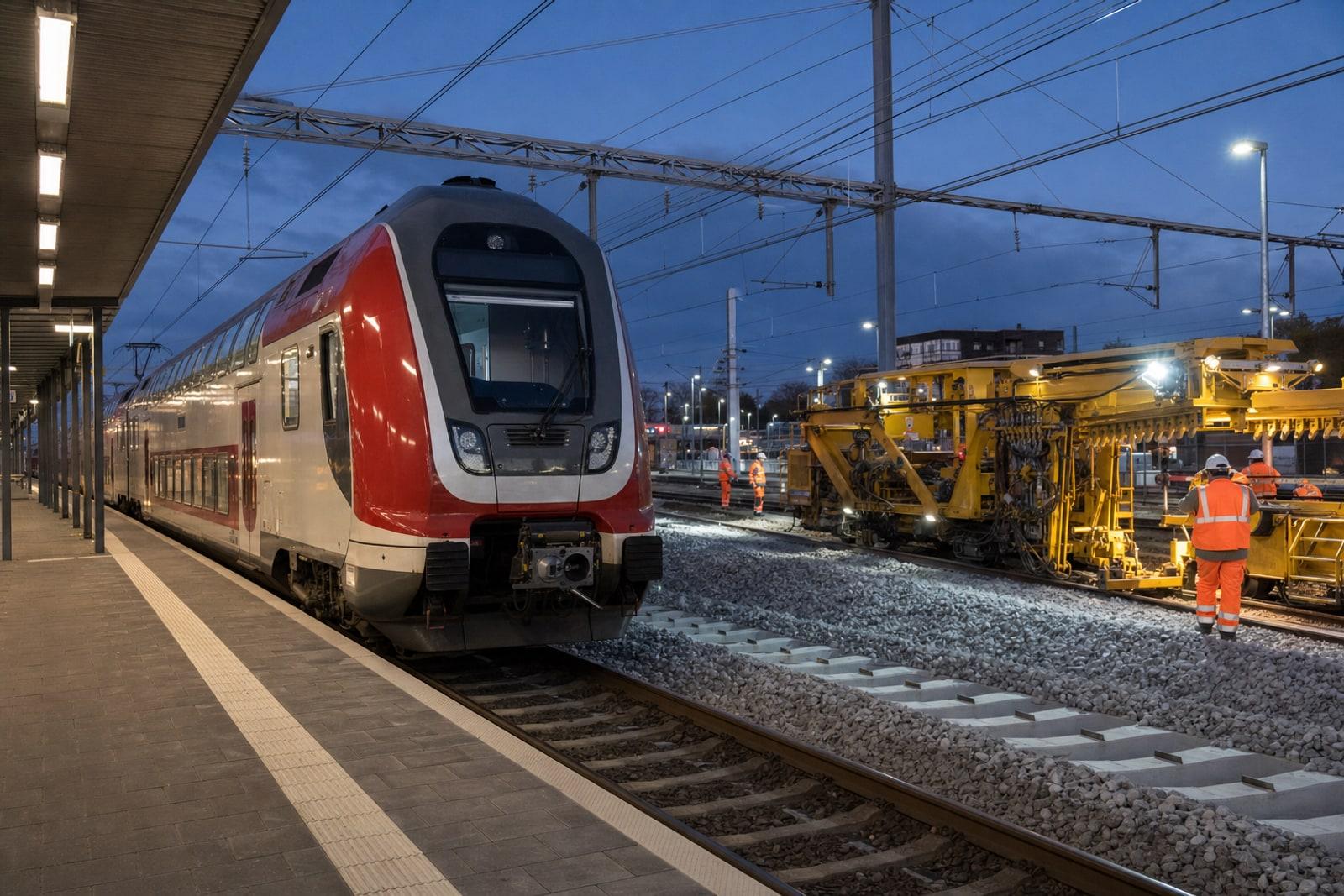
Luxembourg's railways are entering their most intensive year of construction in recent memory. The national operator CFL will renew nearly 30 kilometres of track across the network in 2026, laying more than 50,000 sleepers and some 50,000 tonnes of ballast — a programme that will close sections of every main line at some point this year, including the cross-border arteries to Thionville, Arlon and Trier on which tens of thousands of commuters depend daily.
The works calendar, published by CFL in January, is deliberately built around school holidays, when passenger numbers fall and enough buses can be chartered to replace trains. The company says the effort follows 254 days of works carried out in 2025 and marks the first year of a new 15-year infrastructure management contract worth €4.7 billion, signed with the state in December 2025.
A year of closures, holiday by holiday
The heaviest disruption comes in summer, but no season is spared. According to CFL's published programme, the main interruptions are:
- Carnival (14–22 February): Luxembourg–Arlon and Luxembourg–Bettembourg closed.
- Easter (28 March–12 April): Luxembourg–Arlon, Luxembourg–Ettelbruck/Diekirch, Bettembourg–Esch-sur-Alzette and the Audun-le-Tiche and Rumelange branches closed.
- Summer (16 July–14 September): Luxembourg–Thionville closed from 16 July to 23 August; Luxembourg–Bettembourg from 16 July to 14 August; Luxembourg–Esch-sur-Alzette from 15 to 23 August; the northern line from Ettelbruck to Troisvierges and Gouvy, plus the Wiltz branch and the Trier corridor beyond Wasserbillig, from 24 August to 14 September.
- All Saints (31 October–8 November): Luxembourg–Bertrange-Strassen, Luxembourg–Athus/Longwy and Luxembourg–Ettelbruck/Diekirch closed.
For each closure CFL is deploying replacement buses coordinated with the RGTR and TICE bus networks and Belgium's SNCB. During the summer peak the company expects roughly 200 drivers to operate close to a thousand replacement journeys a day, with details published in its works calendar on cfl.lu and the CFL app.
The cross-border lifelines
The stakes extend far beyond the Grand Duchy's borders. STATEC, Luxembourg's statistics office, counts around 228,300 cross-border workers — close to half the country's workforce — with roughly half commuting from France and the remainder split between Belgium and Germany. The Thionville–Luxembourg line is the busiest of those corridors, which is why its five-and-a-half-week summer closure, from 16 July to 23 August, is the programme's most sensitive item. The Arlon line faces repeated interruptions at Carnival, Easter, Pentecost and early July, while the Trier route via Wasserbillig closes from late August to mid-September.
Much of the disruption serves projects designed precisely to add cross-border capacity. The centrepiece is a new seven-kilometre line between Luxembourg and Bettembourg — a €414 million project, according to Paperjam — that will separate domestic, French and freight traffic on the network's most congested approach. Equipment installation continues through 2026, with full service planned for September 2027. At Howald, a new interchange linking rail and tram is due for completion this year, expanding the approach to the capital from two tracks to four. Bettembourg station, the country's second busiest, is being rebuilt, and level crossings are being eliminated at Dommeldange, Milbech and Colmar-Usines.
Europe's biggest rail spender, per head
The 2026 programme is the opening instalment of the infrastructure management contract signed on 12 December 2025 by mobility minister Yuriko Backes, CFL board chairman Jeannot Waringo and chief executive Marc Wengler. It commits €4.7 billion between 2026 and 2040 to the national network, the Port of Mertert's rail links and 68 stations and stops — two of them, Audun-le-Tiche and Volmerange-les-Mines, on French soil. Backes said the government was fulfilling its coalition pledge "to invest significantly and ambitiously in infrastructure and human resources to ensure a modern, accessible and reliable railway network."
Thanks to this renewed vote of confidence from the government – the railway infrastructure management contract – we now have the framework, visibility and resources needed to anchor rail transport as the backbone of public mobility in Luxembourg and neighbouring regions.
— Marc Wengler, CFL chief executive
The spending sustains a distinction Luxembourg has held for years. Comparisons compiled by the German pro-rail alliance Allianz pro Schiene consistently rank the Grand Duchy first in Europe for per-capita rail infrastructure investment — €587 per resident in 2024, ahead of Switzerland at €480 and Austria at €352, and several times the levels seen in Germany or France. Since 29 February 2020 all public transport within the country has also been free of charge, a world first, though cross-border segments into France, Belgium and Germany still require a ticket.
The logic underpinning the pain is capacity. CFL says passenger numbers have more than doubled in roughly two decades, and more than a thousand passenger and freight trains now run on the compact network daily — pushing it, in the company's words, to the limits of what the existing infrastructure can carry. For commuters, 2026 will be a year of buses, adapted timetables and longer journeys. The bet, backed by €4.7 billion, is that the network that emerges — new Bettembourg line, four-track southern approach, rebuilt stations — will be worth the wait.
Frequently asked
- When is the Luxembourg–Thionville line closed in 2026?
- The Luxembourg–Thionville line is closed from 16 July to 23 August 2026 for track and infrastructure works, with replacement buses operating. Details are published in CFL's works calendar on cfl.lu and in the CFL app.
- Which cross-border lines are affected by CFL's 2026 works?
- All three main cross-border corridors are affected: Luxembourg–Thionville (16 July–23 August), Luxembourg–Arlon (closures at Carnival, Easter, Pentecost and early July, with adapted timetables), and Luxembourg–Wasserbillig–Trier (24 August–14 September). The Athus/Longwy route closes around All Saints (31 October–8 November).
- Why is CFL doing so much work on the network now?
- Passenger numbers have more than doubled in about two decades and over 1,000 trains use the network daily, pushing it to capacity. The 2026 works — nearly 30km of track renewal plus projects like the new Luxembourg–Bettembourg line and the Howald interchange — are the first year of a €4.7bn infrastructure contract running to 2040.
- Will there be replacement buses during the closures?
- Yes. CFL deploys replacement buses for every closure period, coordinated with RGTR, TICE and Belgium's SNCB. During the summer peak, about 200 drivers are expected to run close to 1,000 replacement journeys per day.
Sources(14)
- 1Nous travaillons pour votre mobilité de demain (2026 works programme)CFL · cfl.lu
- 2Les CFL prévoient de nombreuses interruptions ferroviaires en 2026Paperjam · paperjam.lu
- 3CFL annonce des travaux majeurs sur les voies ferrées au Luxembourg en 2026L'essentiel · lessentiel.lu
- 4Travaux d'infrastructure en 2026 : une nouvelle année d'engagement des CFLInfogreen (CFL press release) · infogreen.lu
- 5Luxembourg Confirms Long-Term Investment Framework for Railway InfrastructureChronicle.lu · chronicle.lu
- 6L'État et les CFL renouvellent leurs engagements en faveur d'infrastructures ferroviairesGouvernement du Luxembourg · gouvernement.lu
- 7Key questions about the CFL worksCFL Blog · blogcfl.lu
- 8Germany's rail investment reaches record levels, lags behind neighbours (Allianz pro Schiene data)Clean Energy Wire · cleanenergywire.org
- 9Per capita investment in rail infrastructure in Europe (Allianz pro Schiene data)Statista · statista.com
- 10Domestic payroll employment: +0.2% in the second quarter of 2025 and +0.9% over 12 monthsSTATEC (statistiques.public.lu) · statistiques.public.lu
- 11Cross-Border Workers Constitute 47% of Luxembourg's 500k Workforce in 2023Chronicle.lu · chronicle.lu
- 12Public transport — free since 29 February 2020luxembourg.public.lu (Government of Luxembourg) · luxembourg.public.lu
- 13Residents of Luxembourg celebrate three years of free public transportEU Urban Mobility Observatory (European Commission) · urban-mobility-observatory.transport.ec.europa.eu
- 14Government renews CFL rail infrastructure managementPaperjam (English) · en.paperjam.lu
Related by topic