Middle East
Lebanon, Israel and US sign Washington framework as Hezbollah rejects deal
A US-brokered trilateral framework signed in Washington maps a path to disarm Hezbollah and pull Israeli troops back — but the armed group's flat rejection casts doubt on whether it can hold.
By Camille Reuter · · 4 min read
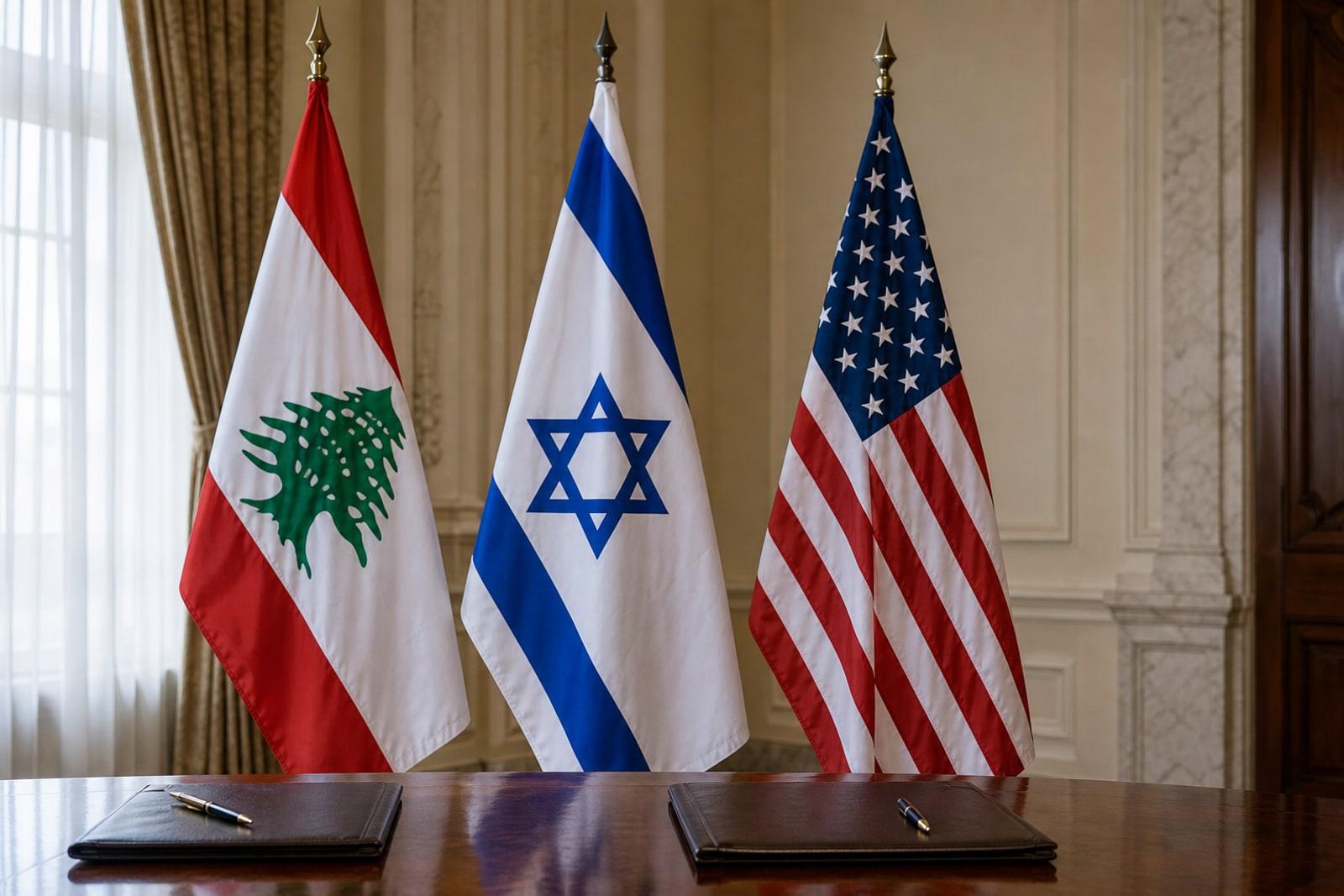
WASHINGTON — Lebanon, Israel and the United States signed a trilateral framework agreement at the US State Department on Friday, a rare diplomatic opening on one of the Middle East's most combustible frontiers that Washington portrayed as the first step toward a formal peace between two long-standing adversaries. Within hours the optimism collided with reality: Hezbollah, the most powerful armed force on the Lebanese side and a party absent from the negotiations, rejected the deal outright.
The accord was signed by Israel's ambassador to the United States, Yechiel Leiter, and Lebanon's ambassador, Nada Hamadeh, in the presence of Secretary of State Marco Rubio. It capped five rounds of US-mediated talks in Washington, the latest running about four days. The framework does not end the conflict; officials cast it instead as a road map for de-escalation after months of fighting that Lebanese authorities say has killed more than 4,200 people, and after a November 2024 ceasefire that repeatedly broke down.
What the framework commits the parties to do
According to American and Israeli statements, the agreement lays out a sequenced process rather than a settled peace. Its core provisions, as described by the parties, include:
- a “clear process” to restore Lebanese sovereignty, disarm Hezbollah and dismantle its military infrastructure;
- two pilot zones near the border, where the Lebanese Armed Forces would assume control and Hezbollah would be dismantled before reconstruction and the return of civilians;
- a trilateral Military Coordination Group for Lebanon, facilitated by the United States, to oversee implementation;
- a phased Israeli pullback — Israel says it will “return to its borders” only once the threat to its citizens is removed.
Lebanon's ambassador framed the signing as the opening of a long road, calling it “a first step on the road to restoring Lebanese sovereignty and territorial integrity, securing a permanent and final cessation of hostilities.” Rubio was more circumspect about how much had actually been achieved.
It's the beginning of the beginning. There's a lot of work ahead. — Marco Rubio, US Secretary of State
Hezbollah's rejection
The framework's central weakness is that the group it is designed to disarm never agreed to it. Hezbollah's leader, Naim Qassem, insisted that Israel must withdraw unconditionally and ruled out any normalisation of relations. The movement's lawmaker Hassan Fadlallah was blunter still, warning that Lebanon's government could not impose the deal without tearing the country apart.
“The course being pursued by Lebanese authorities amounts to unilateral, gratuitous concessions that will only undermine the country and serve the interests of the Israeli enemy,” Fadlallah said, adding that the accord could be enforced only “with American support” by plunging Lebanon into “civil war.”
That rejection matters because the deal's sequencing — disarmament first, full Israeli withdrawal later — rests on the Lebanese army confronting a better-armed movement it has historically been neither willing nor able to face down. Since the 2024 ceasefire, the army has deployed south of the Litani River alongside UN peacekeepers, but it remains heavily dependent on foreign funding and has not forced Hezbollah to give up its weapons.
A fragile sequence, and a wider realignment
On the Israeli side, Prime Minister Benjamin Netanyahu made clear that troops are not leaving soon. “Israel remains in the security zone in southern Lebanon. This is a major achievement,” he said, presenting the framework as a security win rather than a concession. Finance Minister Bezalel Smotrich has signalled an open-ended presence, arguing Israel needs “defendable borders.” Israeli forces still hold roughly a fifth of Lebanese territory.
The agreement is also a marker of a shifting region. It followed the death of Iran's supreme leader earlier this year and a US-Iran memorandum reached on 17 June that called for an end to military operations “on all fronts, including in Lebanon” — the diplomatic backdrop that made a Lebanese-Israeli text conceivable. Leiter captured Israel's reading bluntly: “Iran is out, Hezbollah is out, and the road to peace between Israel and Lebanon is in.” Fadlallah, by contrast, cast the Washington signing as an attempt to derail Tehran's own negotiating track.
For Europe, the stakes are concrete. Lebanese stability bears directly on migration pressures and on the southern flank of EU and NATO members, and European contingents form a substantial part of the UN peacekeeping force, UNIFIL, that patrols the border. The European Union has long bankrolled Lebanon's army and its hosting of refugees, betting that a functioning Lebanese state is the cheapest insurance against another exodus across the Mediterranean. Whether this framework strengthens that state or merely papers over its central fracture will not be clear for months.
Rubio, for his part, conceded the obvious. The hard part — turning a signed page into disarmament on the ground — has not yet begun.
Frequently asked
- Who signed the framework agreement?
- Israel's ambassador to the US Yechiel Leiter and Lebanon's ambassador Nada Hamadeh signed it, witnessed by US Secretary of State Marco Rubio, after five rounds of US-mediated talks at the State Department in Washington.
- Does the agreement end the Israel-Lebanon conflict?
- No. Officials described it as a framework and a 'first step' — a sequenced road map conditioned on Hezbollah's disarmament and Lebanese army control, not a final peace treaty.
- Why does Hezbollah's rejection matter?
- Hezbollah is the strongest armed actor in Lebanon and was not party to the deal. Without its compliance, the Lebanese army would have to disarm it by force — something it has long been unable or unwilling to do — which a Hezbollah MP warned could mean civil war.
- What does the deal mean for Europe?
- Lebanese stability affects migration toward the EU and the bloc's southern flank. European troops form a significant part of the UN peacekeeping force UNIFIL, and the EU has long funded Lebanon's army and its hosting of refugees.
Sources(12)
- 1Israel-Lebanon framework agreement sets process to disarm Hezbollah, Rubio saysAl-Monitor · al-monitor.com
- 2US-Israel-Lebanon sign trilateral agreement in Washington, FridayThe Jerusalem Post · jpost.com
- 3Lebanon, Israel, US sign trilateral framework agreement in WashingtonGulf News · gulfnews.com
- 4Lebanon, Israel, US sign trilateral framework agreement in WashingtonDeccan Chronicle · deccanchronicle.com
- 5What is the framework agreement signed by Israel and Lebanon?Al Jazeera · aljazeera.com
- 6US announces framework agreement between Israel and LebanonAl Jazeera · aljazeera.com
- 7Middle East war: Lebanon, Israel and US sign framework agreement in WashingtonFrance 24 · france24.com
- 8Israel, Lebanon sign framework agreement with U.S. in 'first step' toward peaceCBC News · cbc.ca
- 9Israel and Lebanon sign framework agreementAxios · axios.com
- 10Hezbollah rejects Lebanon-Israel deal, warns of civil warThe New Arab · newarab.com
- 11Israel, Lebanon sign framework deal for slight IDF withdrawal after days of talks in DCThe Times of Israel · timesofisrael.com
- 122024 Israel–Lebanon ceasefire agreementWikipedia · en.wikipedia.org
Related by topic