Iran
Iran Stages a Mass Farewell to Khamenei as His Son and Successor Stays Unseen
Four months after the supreme leader was killed in US-Israeli strikes, a near-weeklong state funeral doubles as a show of continuity — with his son and named successor, Mojtaba, nowhere in sight.
By Léa Hoffmann · · 5 min read
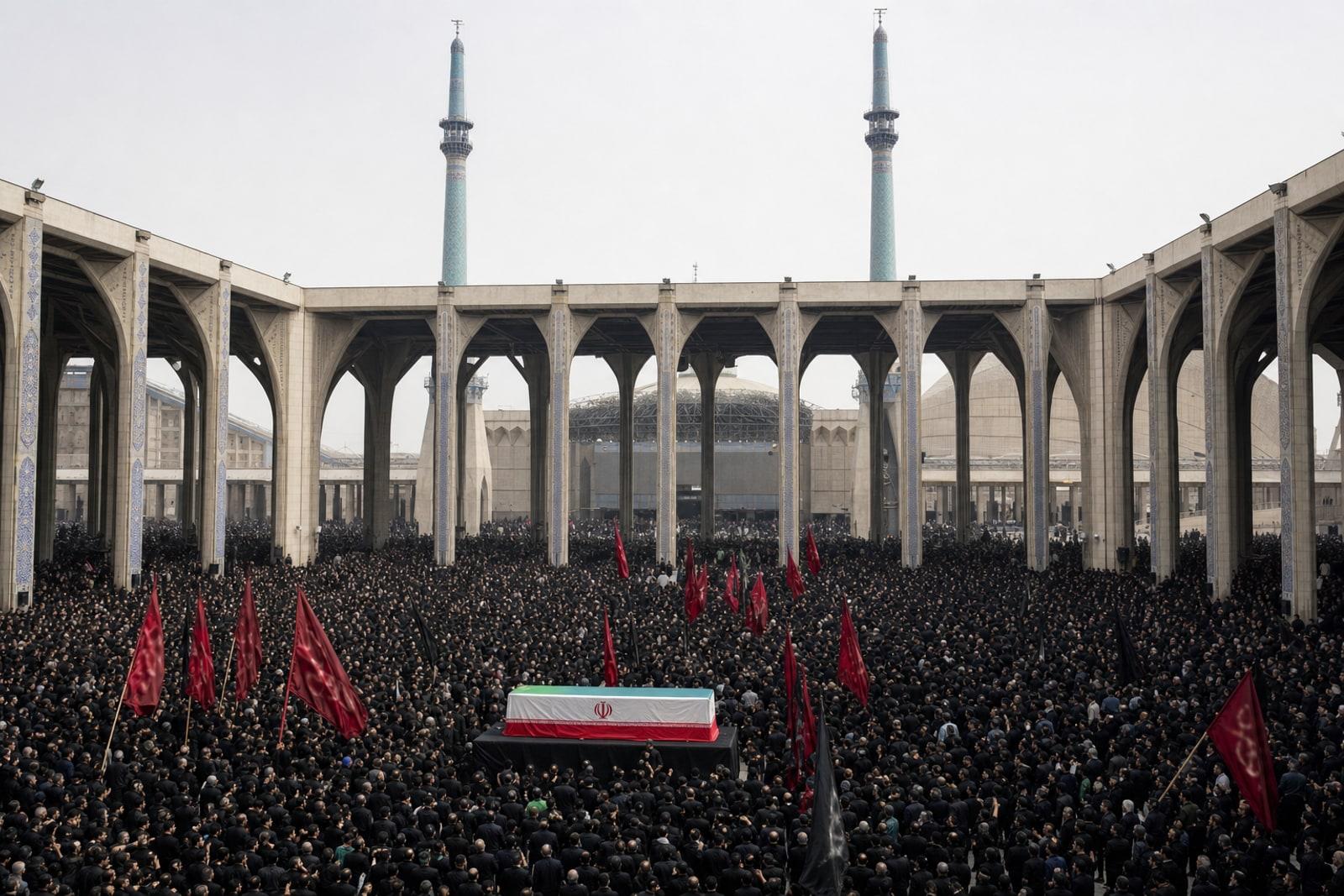
Iran began a near-weeklong state funeral for its slain supreme leader, Ali Khamenei, on 3 July, turning Tehran into the stage for a vast choreographed farewell designed to project continuity and strength four months after he was killed. The ceremonies are less a moment of uncertainty than a demonstration that the succession has already been settled — and that the Islamic Republic intends to look unbroken.
Khamenei, who had led Iran since 1989, was killed on 28 February in US-Israeli airstrikes at the outset of the 2026 Iran war, according to Al Jazeera and other outlets; the government confirmed his death on 1 March and declared 40 days of mourning. His body has lain in state at the Imam Khomeini Grand Mosalla, the sprawling prayer complex in the capital, before a procession that authorities have spread across five cities in two countries.
The choreography of a farewell
Officials designed the rites as a show of mass devotion. Mourners packed the Mosalla, beating their chests and chanting "revenge, revenge" and "death to America," many carrying red flags, a Shia symbol of vengeance, according to CBS News and Al Jazeera. Iranian authorities predicted as many as 30 million participants nationwide; other estimates put expected turnout at 15 to 20 million, which would make it the largest state funeral in the country's history.
The procession is scheduled to move from Tehran to the clerical center of Qom, then to the Iraqi shrine cities of Najaf and Karbala, before a final procession and burial at the Imam Reza shrine in Mashhad later in the week. Representatives of more than 100 countries attended the opening, including at least eight heads of state or government and a dozen parliamentary speakers — among them Pakistani Prime Minister Shehbaz Sharif, Russia's Dmitry Medvedev and Armenian Prime Minister Nikol Pashinyan.
We have come not for the funeral but for revenge.
That chant, from a eulogist at the Grand Mosalla, captured the defiant register of an event staged as much for a domestic and foreign audience as for grief. "We warn the enemies of Iran, especially the US and the Zionist regime, to avoid any miscalculation," said senior military commander Ali Abdollahi, quoted by Al Jazeera.
A dynastic succession, quietly contested
The most striking feature of the farewell is who is not there. Mojtaba Khamenei, the late leader's son and a former figure in the Revolutionary Guards, was named Iran's third supreme leader on 9 March by the Assembly of Experts, the 88-member clerical body empowered to choose the office under the constitution. He has not appeared in public since, and is not attending his father's funeral — reportedly kept away for security reasons after Israeli threats to target him.
Mojtaba is believed to have been wounded in the same 28 February strikes that killed his father, mother and wife, and has communicated only through written statements relayed by Iranian media, according to Radio Free Europe/Radio Liberty. His invisibility complicates a spectacle meant to signal stability at the top.
The succession itself was contested. Under Article 111 of the constitution, an interim leadership council took charge on 1 March, grouping President Masoud Pezeshkian, the chief justice and a senior Guardian Council cleric. The Assembly then met in early March — first online, then in person — and installed Mojtaba. The New York Times reported he won 59 of 88 votes, above the required two-thirds; other outlets reported different tallies. Names floated as alternatives had included former president Hassan Rouhani and Hassan Khomeini, a grandson of the republic's founder. Accounts of pressure from the Revolutionary Guards on Assembly members, and a partial boycott of one session, underscored unease over installing the son of the previous leader.
- What is confirmed: Khamenei is dead; Mojtaba has been formally named his successor.
- What is unresolved: whether a leader who has not been seen in public can consolidate authority over rival power centers.
The stakes: nuclear file, region and oil
A leadership change at the apex of the Islamic Republic reverberates well beyond Iran. On the nuclear question, the picture is murky by design. Tehran told the International Atomic Energy Agency in February that normal safeguards had become "legally untenable and materially impracticable" amid the war, and the agency says it can no longer verify Iran's enrichment activity or account for its stockpile — though it has reported no evidence of active weaponization. Before the war, the IAEA had documented Iran amassing a large quantity of uranium enriched to 60 percent, close to weapons grade.
US-Iran talks were paused for the week of the funeral. Analysts say the nuclear file has been largely deferred, with negotiators focused for now on the Strait of Hormuz, through which a fifth of the world's oil passes. Energy markets have whipsawed accordingly: Brent crude jumped to around $80 a barrel in early March and briefly topped $100 as shipping through the strait was disrupted — a shock the International Energy Agency ranked among the largest in the oil market's history — before falling roughly 20 percent from its 2026 peak on ceasefire hopes. After a late-June deal to halt hostilities and restore free transit, Brent settled near $72.
For now, the funeral offers Iran's establishment a stage to insist that the system outlasts any one man. "The noble and deep-rooted Iranian people... will not give up on the blood of their leader," parliament speaker Mohammad Bagher Ghalibaf said. Whether that projected unity survives the arrival of an unseen new supreme leader is the question the choreography cannot answer.
Frequently asked
- Is Ali Khamenei dead or being sidelined?
- He is dead. Iran confirmed on 1 March 2026 that Khamenei was killed on 28 February in US-Israeli airstrikes. The July events are his state funeral, not a removal from office.
- Who has succeeded Khamenei as supreme leader?
- The 88-member Assembly of Experts named his son, Mojtaba Khamenei, as Iran's third supreme leader on 9 March 2026. The New York Times reported he won 59 of 88 votes, though the choice was contested and he has not appeared publicly since.
- Why is the new supreme leader not at the funeral?
- Mojtaba Khamenei is reportedly kept away for security reasons after Israeli threats to target him. He is believed to have been wounded in the strikes that killed his father, mother and wife, and communicates only through written statements.
- What does the transition mean for oil and the nuclear standoff?
- The IAEA has lost the ability to verify Iran's enrichment, and US-Iran talks are paused, with the Strait of Hormuz the immediate dispute. Oil swung from above $100 to about $72 a barrel as war disruption eased into a June ceasefire.
Sources(12)
- 1Iran confirms Supreme Leader Ali Khamenei dead after US-Israeli attacksAl Jazeera · aljazeera.com
- 2Dayslong funeral for slain Supreme Leader Ayatollah Ali Khamenei begins in TehranNPR · npr.org
- 3Iran's Khamenei funeral: Which world leaders are attending?Al Jazeera · aljazeera.com
- 4U.S.-Iran Latest: Mourners chant for revenge as Iran begins dayslong funeral of slain supreme leaderCBS News · cbsnews.com
- 5Still No Sign Of Supreme Leader As Iran Kicks Off Funeral Rites For KhameneiRFE/RL · rferl.org
- 62026 Iranian supreme leader electionWikipedia · en.wikipedia.org
- 7State funeral of Ali KhameneiWikipedia · en.wikipedia.org
- 8Ayatollah Khamenei Funeral: What We KnowNewsweek · newsweek.com
- 9Iran Prepares for Week of Funeral Processions for Ayatollah Ali KhameneiTIME · time.com
- 10Oil prices rise as U.S. and Iran reach deal to halt attacks, U.S. oil above $70 per barrel againCNBC · cnbc.com
- 11Oil drops 20% from 2026 peak on optimism over U.S.-Iran ceasefire talksCNBC · cnbc.com
- 12Tehran Begins Multi-Stage Funeral for Khamenei; Successor Mojtaba Remains AbsentIranWire · iranwire.com
Related by topic