European auto industry
Renault to cut 800 engineering jobs in France amid Chinese EV competition
The carmaker will cut about 800 engineering jobs in France by the end of 2027 through voluntary departures, part of a wider 15-20% reduction as it races to match Chinese rivals.
By Marc Weber · · 4 min read
Renault plans to cut about 800 engineering jobs in France by the end of 2027, the carmaker said, as Europe's automakers scramble to match the speed and cost of Chinese electric-vehicle rivals. The reductions, presented on 24 June, will be made through voluntary departures rather than compulsory layoffs, according to Reuters, which reported the plan from a briefing by Renault managers.
The French engineering division employs about 5,500 people — roughly half of Renault's global engineering workforce — so the cuts amount to around 15% of that pool. They form the French slice of a broader reorganisation that Chief Executive François Provost has built around a single idea: that the company must learn to design cars almost as fast as its Chinese competitors, or be priced out of its own market.
What Renault is cutting, and what it is keeping
The reductions are not a blanket retreat from engineering. Maximilien Fleury, Renault's human resources chief for France, set out a plan that pairs the job losses with retraining and targeted hiring. Even as roles disappear, the company says it intends to invest in the skills it now considers decisive — software, artificial intelligence and electrification.
- About 800 engineering jobs in France to go by the end of 2027, via voluntary departures.
- 2,500 workers to be retrained for new tasks.
- 150 to 200 new engineers to be hired, mainly for EV, software and AI roles.
- Union approval of the transformation plan is expected in July 2026, with implementation starting in September.
The French plan sits inside a larger target announced earlier this year: a global engineering reduction of 15% to 20% over two years, or up to roughly 2,400 of an estimated 11,000 to 12,000 engineers worldwide. Renault has said the core of its fundamental design and technology work will stay concentrated in France.
A race against 'China speed'
Renault's chief technology officer, Philippe Brunet, framed the overhaul bluntly as a question of pace, telling reporters his priority was to compress how long it takes to bring a car to market. Chinese manufacturers, he argued, have rewritten the clock for the whole industry.
All other manufacturers are suffering, the Koreans, the Japanese in Europe, or other Europeans, including us. We must be able to compete against this.
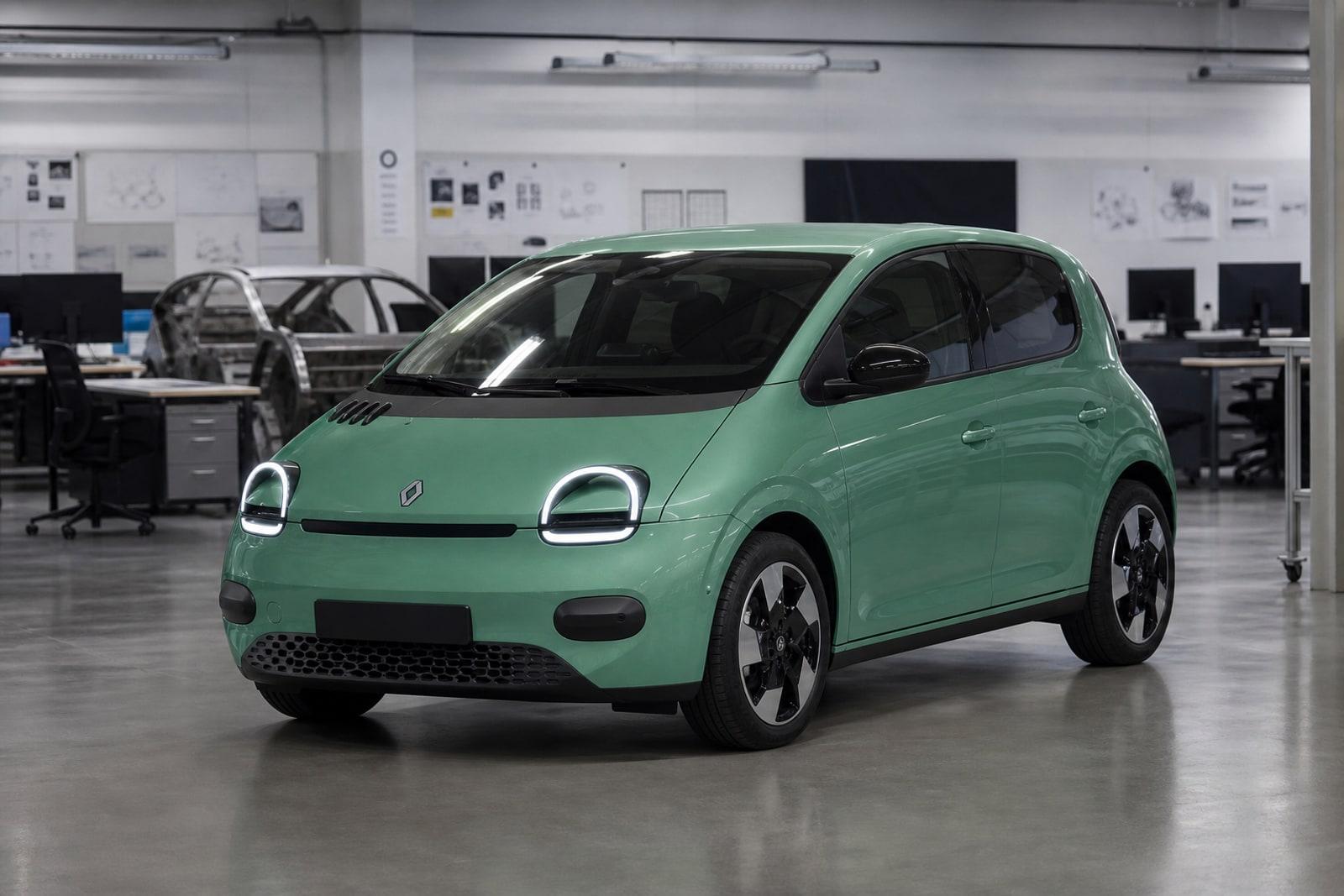
Brunet said he wanted to strip out steps and meetings that slow vehicle programmes, summarising the goal in three words: "My issue is speed." The benchmark Renault keeps citing is the new Twingo E-Tech, a small electric city car developed in about 21 months — roughly half the pace of earlier Renault programmes — with heavy input from the company's Ampere development centre in Shanghai, which employs around 100 engineers and has run since 2024.
Provost, who took over as chief executive in July 2025 after Luca de Meo's departure for the luxury group Kering, has set a target of 36 new models over five years, each built on a development cycle of about two years rather than the four to five years long typical in Europe. He has been candid that the hardest part is cultural, not technical.
"The problem is not what we have to do but how we change the mindset of our engineers and the organisation to develop as quickly as our Chinese competitors."
A continent under pressure
Renault's move is a symptom of a wider squeeze. Chinese carmakers have more than tripled their share of the European market in roughly two years, offering technologically advanced electric models at prices European brands struggle to match. By the second quarter of 2024, Chinese-built electric vehicles — including foreign marques manufactured in China — accounted for 27.2% of all EVs sold in the EU, with Chinese brands alone at about 14.1%, according to industry data.
Brussels has tried to slow that advance. In October 2024 the European Commission imposed countervailing duties of between 7.8% and 35.3% on Chinese-made EVs, on top of the standard 10% tariff on car imports, citing state subsidies. By January 2026 the Commission was moving to replace those duties with a system of minimum import prices negotiated with Chinese manufacturers — a shift that eases border friction but does little to close the underlying cost gap.
That gap is what is now reshaping European factories and design offices. For Renault, the calculation is that survival depends less on protection than on rebuilding how it works: fewer engineers, faster cycles, and a development model openly borrowed from the rivals it is trying to hold off.
Why it matters
The decision to thin out engineering — the part of a carmaker that embodies its long-term capability — is a measure of how serious the pressure has become. Cutting assembly-line jobs is a response to weak demand; shedding engineers signals a structural rethink of where and how value is created. As Europe's industrial core absorbs the shock of Chinese competition, Renault's gamble is that it can shrink its engineering base and still out-design the companies forcing the change. The next two years will test whether that is restructuring or retreat.
Frequently asked
- How many jobs is Renault cutting and where?
- Renault plans to cut about 800 engineering jobs in France by the end of 2027 through voluntary departures — around 15% of its 5,500 French engineering staff. That is part of a broader global engineering reduction of 15-20%, or up to roughly 2,400 of an estimated 11,000-12,000 engineers.
- Why is Renault making the cuts?
- Management says it must compete with Chinese EV makers on cost and development speed. CEO François Provost is pushing a roughly two-year 'China speed' development cycle and 36 new models over five years, with the 21-month Twingo E-Tech as the model.
- Are the cuts compulsory layoffs?
- No. Renault says the reductions will be achieved through voluntary departures, alongside retraining 2,500 workers and hiring 150-200 new engineers for software, AI and electrification roles. Union approval was expected in July 2026, with implementation from September.
Sources(11)
- 1Renault seeks to cut 800 jobs in engineering in FranceReuters (via Investing.com) · investing.com
- 2Renault Plans to Cut 800 Engineering Jobs in France by 2027Global Banking & Finance Review (Reuters) · globalbankingandfinance.com
- 3Renault seeks to cut 800 jobs in engineering in FranceYahoo Finance (Reuters) · finance.yahoo.com
- 4Le groupe Renault annonce un plan de départs volontaires concernant 800 ingénieurs en France d'ici fin 2027franceinfo · franceinfo.fr
- 5Renault cuts up to 2,400 engineers in 'China speed' campaignAutomotive World · automotiveworld.com
- 6Renault to cut up to 2,400 engineers amid China competitionAutomotive News · autonews.com
- 7Renault to cut up to 20% of engineers as competition from China risesThe Detroit News · detroitnews.com
- 8Renault plans to develop all European models at China speed, CEO Provost saysAutomotive News Europe · autonews.com
- 9Renault Group appoints François Provost as Chief Executive Officer and DirectorRenault Group · media.renaultgroup.com
- 10Slamming the Brakes: The EU Votes to Impose Tariffs on Chinese EVsCSIS · csis.org
- 11EU and China take new step to resolve row over subsidised electric vehiclesEuronews · euronews.com
Related by topic