Energy & climate
Heatwave cuts French nuclear output, but Cattenom keeps running on the Moselle
A record June heatwave forced EDF to throttle reactors across France to protect overheating rivers. On Luxembourg's border, the contested Cattenom plant stayed online — for now.
By Marc Weber · · 4 min read
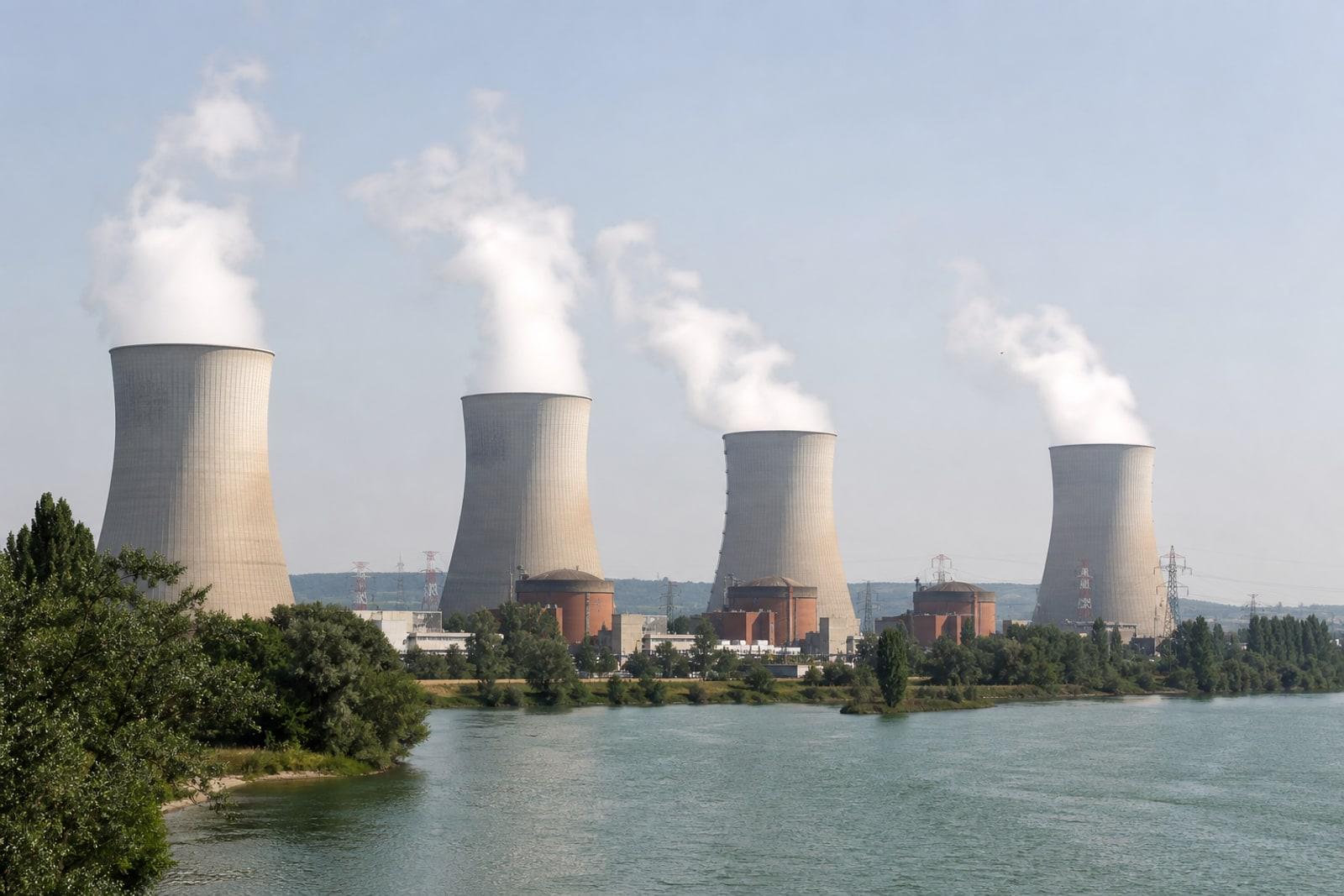
The heat that smothered Europe in late June pushed France's electricity system to one of its sternest tests in years — and trained a spotlight on the cluster of cooling towers that rise just across Luxembourg's south-eastern border.
As a record-breaking heatwave drove river temperatures toward their regulatory ceilings, the state utility EDF shut three reactors outright and throttled several more rather than pump over-warm water back into France's rivers. By 26 June the lost capacity reached about 8.7% of the nuclear fleet, EDF said — roughly 5.5 gigawatts of the 63 GW installed.
The contested plant on Luxembourg's doorstep, Cattenom, was not among them. As of this week it was still generating on the Moselle — and was, in fact, asked by the grid operator to stay online. But the same thermal rules that idled reactors elsewhere hang over it, and the episode has revived a decades-old argument the Grand Duchy has never let go.
The reactors France had to throttle
France recorded its hottest day since national records began in 1947 on 24 June, with the country-wide temperature index near 30°C and a single high of 44.3°C at Pissos in the south-west, according to Météo-France figures reported by Al Jazeera and others. Météo-France placed dozens of departments under its top "red" heat alert.
French nuclear plants draw river water to cool their condensers and return it a few degrees warmer. To protect aquatic life, French law caps how hot that discharge — and the river itself — may get. As those ceilings approached, EDF acted: a reactor at Golfech on the Garonne came off line on 23 June, followed on 25 June by units at Bugey on the Rhône and at Nogent-sur-Seine on the Seine, where rules require the river to stay below 28°C on average and rise no more than 3°C downstream. Output was also trimmed at Chooz, Saint-Alban and Blayais. Combined with surging air-conditioning demand and weak wind generation, the curbs lifted wholesale power prices to their highest in years.
France's nuclear safety regulator, the ASNR, stressed the situation remained manageable and short of the emergency waivers granted in the past. "We are still a long way from a derogation request," the head of its nuclear-installations directorate, Rémy Catteau, told Agence France-Presse on 26 June — a contrast with the summer of 2022, when EDF won temporary permission to keep discharging hotter water.
Cattenom's 28°C ceiling on the Moselle
Cattenom's four 1,300-megawatt reactors, commissioned between 1986 and 1992 about 22 kilometres upstream of Luxembourg, draw roughly 890 million cubic metres of Moselle water a year. They run under their own hard limits: the plant may not warm the river by more than 1.5°C, and the Moselle must not exceed 28°C downstream.
When the river runs hot, EDF can lean on buffers before cutting power:
- the 95-hectare Lac de Mirgenbach beside the plant, holding about 7.3 million cubic metres that can be circulated to ease reliance on the river;
- the Pierre-Percée reservoir further upstream in Meurthe-et-Moselle, which can be released to prop up the Moselle's flow during low water.
Only if those fail must Cattenom reduce output or shut down during heat peaks — the last-resort sequence Luxembourg's environment minister, Serge Wilmes, set out for parliament last year. That margin has held so far. During the previous summer's heat, the Moselle reached 28°C on 2 July 2025 at the German measuring station of Palzem without forcing a Cattenom shutdown, the government said. This week the grid operator RTE went further, asking EDF to guarantee that at least ten reactors — Cattenom among them — stayed available on 27-28 June to steady the network.
"France has sufficient generation capacity to meet electricity demand, including in the event of outages at certain production facilities," RTE said.
Luxembourg's long fight over the plant
For Luxembourg, Cattenom's resilience to heat is only the latest front in a confrontation that predates the climate debate. The Grand Duchy has campaigned for the plant's closure for years, citing its age, repeated incidents and its position on a shared watershed barely 20 kilometres away.
The dispute is sharpening because Cattenom is approaching the 40-year mark its reactors were originally designed for, with the first unit hitting that threshold in 2026. EDF wants to extend their lives well beyond it; Luxembourg's government, acting on advice from its radiation-protection service, has formally opposed prolonging "high-risk" plants such as Cattenom, Tihange and Doel, and has demanded that all four reactors be checked for the kind of corrosion that idled one unit for inspection. By last summer, 27 Luxembourg municipalities had joined an alliance against the plant.
None of that changes the immediate picture: through the hottest days of June 2026, Cattenom kept generating while reactors elsewhere in France stood down. But the heatwave underlined the bind the Grand Duchy keeps pointing to — a 1980s reactor fleet, on a warming river, asked to run longer in a climate its designers never planned for.
Frequently asked
- Did the Cattenom nuclear plant shut down during the June 2026 heatwave?
- No. As reactors at Golfech, Bugey and Nogent-sur-Seine were taken offline, Cattenom kept running on the Moselle, and grid operator RTE asked EDF to keep it available on 27-28 June.
- What temperature limits apply to Cattenom on the Moselle?
- The plant may not warm the Moselle by more than 1.5°C, and the river must not exceed 28°C downstream. If its buffer reservoirs cannot keep it within limits, Cattenom must reduce output or stop.
- Why does Luxembourg oppose Cattenom?
- Luxembourg, about 22 km downstream, has long sought the plant's closure over its age, incidents and the shared watershed, and opposes EDF's plans to run the reactors beyond 40 years; the first reaches that mark in 2026.
Sources(12)
- 1La canicule réduit la production du parc nucléaire de 8,7%, indique EDF (AFP)Connaissance des Énergies / AFP · connaissancedesenergies.org
- 2France heatwave: Rising river temperatures trigger shutdown of nuclear reactorsEuronews · euronews.com
- 3Reactors Shut Down As France's Nuclear Output Hit By European HeatwaveNucNet · nucnet.org
- 443C heat cuts 6% of French nuclear capacity, more curbs possibleMontel News · montelnews.com
- 5Réchauffement de la Moselle : comment la centrale nucléaire de Cattenom s'adapte ?Le Quotidien · lequotidien.lu
- 6Été chaud : la température de la Moselle est montée jusqu'à 28°C cet étéL'essentiel · lessentiel.lu
- 7Europe's extreme heat is shutting down power plantsMIT Technology Review · technologyreview.com
- 8France records hottest-ever day as 40 drown trying to escape heatwaveAl Jazeera · aljazeera.com
- 9Cattenom Nuclear Power PlantWikipedia · en.wikipedia.org
- 10Luxembourg Voices Concerns over Potential Life Extension of Cattenom Nuclear Power PlantChronicle.lu · chronicle.lu
- 11Le gouvernement confirme son opposition à la prolongation de la centrale de CattenomLe Quotidien · lequotidien.lu
- 12Nucléaire : 27 communes du Luxembourg veulent faire fermer CattenomL'essentiel · lessentiel.lu
Related by topic