Organised crime
Europol maps 731 criminal networks embedded in Europe's economy
The agency's new threat assessment counts more than 400,000 members across 118 nationalities and warns most groups now hide inside legal businesses — a flag for financial hubs like Luxembourg.
By Camille Reuter · · 4 min read
Europol has identified 731 criminal networks that pose the highest threat to the European Union's internal security, a sprawling underworld of more than 400,000 members drawn from 118 nationalities that increasingly operates from inside the legal economy rather than its margins.
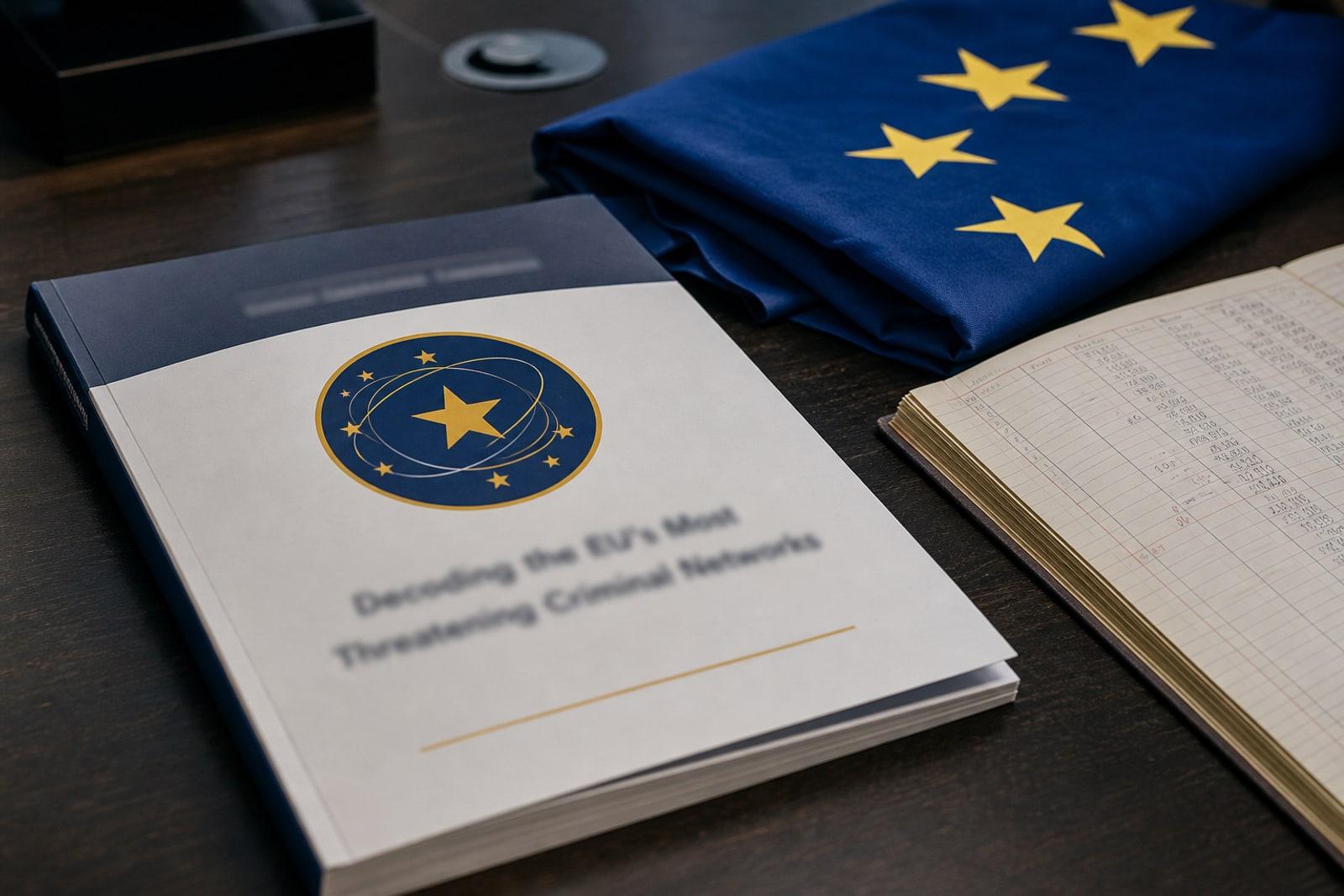
The figures come from the agency's second edition of its flagship mapping exercise, Decoding the EU's Most Threatening Criminal Networks: Issue 2 – The Blueprint of Criminal Opportunism, presented at a press conference in Brussels on 26 June 2026 alongside the Cyprus Presidency of the Council of the EU and the European Commission. It updates a first report published in 2024, which analysed 821 networks and set out a framework describing them as agile, borderless, controlling and destructive.
The networks are, in Europol's words, primarily engaged in drug trafficking and fraud. But the assessment's central warning is about reach: 85% of these groups exploit or abuse legal business structures to facilitate and conceal their activities, blurring the line between the criminal economy and the lawful one.
The markets they dominate
Drug trafficking remains the single largest line of business, but Europol has flagged fraud — much of it online — as the fastest-growing area of organised crime. The most threatening networks also run trafficking in human beings, migrant smuggling and property crime, and they share a common need: to move and disguise the proceeds.
That is where legal businesses come in. Front companies in cash-intensive and cross-border sectors let networks launder money, win contracts and embed themselves in the formal economy. Jürgen Ebner, Europol's Acting Executive Director, described an adversary that increasingly resembles a corporation.
“They have a very strong financial backup. They use sophisticated countermeasures. They use high levels of corruption. They are globally internationally connected cells across the EU and beyond, so an international enterprise,” Ebner said.
Corruption and digital tools
The report frames corruption and technology as the twin enablers of modern organised crime. Networks bribe officials and intimidate to obstruct investigations, while encrypted communications, anonymising tools and, increasingly, artificial intelligence accelerate their operations and complicate enforcement.
“All crime is nurtured online, is accelerated by AI and technology,” Ebner told reporters — a shift that turns once-local gangs into transnational enterprises able to recruit, defraud and coordinate across the bloc and beyond. Europol has separately reported that fraud schemes are now the fastest-growing area of internet-enabled organised crime.
A financial hub on alert
For Luxembourg, the assessment lands close to home. As one of the EU's largest international financial centres, the Grand Duchy is less exposed to local crime than to the laundering of money generated elsewhere — precisely the cross-border flows Europol describes.
Luxembourg's own 2025 National Risk Assessment, published by the Ministry of Justice and the financial supervisor CSSF, reaches a parallel conclusion: money-laundering threats come mainly from the proceeds of predicate offences committed abroad, given the country's position as an international financial centre. It names fraud and forgery, criminal tax offences and corruption as the main external threats — the same markets Europol places at the heart of the EU's most dangerous networks.
The Luxembourg review rates banks, investment firms, electronic-money and payment institutions, virtual asset service providers and life insurance as carrying high inherent money-laundering risk, alongside legal and accounting professionals, with legal arrangements judged the most exposed of all. Mitigation measures, it says, bring most residual risks down to medium.
The enforcement response
Europol's prescription is to stop chasing individual offenders and instead dismantle entire networks — their leadership, their infrastructure and the assets that sustain them — through cross-border cooperation and following the money.
The strength of criminal networks lies in their ability to operate across borders. Therefore, our strength must lie in our ability to work across them.
That call from Themistos Arnaoutis, Chief of the Cyprus police, dovetails with a push in Brussels to give the agency more muscle. On 24 June 2026, the European Commission proposed a strengthened Europol mandate — including automated information-sharing through a Police Shared Data Space, Europol support offices inside member states, a technology and innovation hub, and closer work with Eurojust and the European Public Prosecutor's Office. Reporting on the package says it would roughly double Europol's budget to about €3 billion.
The proposals arrive amid a leadership transition at the agency: Catherine De Bolle stepped down as Executive Director on 1 May 2026, leaving Ebner at the helm in an acting capacity as the report — and the case for a bigger Europol — was put before Europe's governments.
Frequently asked
- How many criminal networks did Europol identify?
- Europol's 2026 assessment identifies 731 criminal networks judged to pose the highest threat to EU internal security, with more than 400,000 members drawn from 118 nationalities.
- What crimes do these networks focus on?
- They are primarily engaged in drug trafficking and fraud, alongside human trafficking, migrant smuggling and property crime, and 85% exploit legal business structures to launder and hide proceeds.
- Why does the report matter for Luxembourg?
- As a major international financial centre, Luxembourg's chief money-laundering threat is the proceeds of foreign crimes — exactly the cross-border flows Europol describes — according to its 2025 National Risk Assessment.
- What enforcement response is being urged?
- Europol urges dismantling entire networks and their assets, not just arresting individuals. On 24 June 2026 the Commission proposed a stronger Europol mandate and reportedly about doubling its budget to €3 billion.
Sources(11)
- 1The blueprint of criminal opportunism – Decoding the EU's most threatening criminal networks - Issue 2Europol · europol.europa.eu
- 2The DNA of organised crime is changing – and so is the threat to EuropeEuropol · europol.europa.eu
- 3Press conference: new edition of the Europol mapping reportEuropol · europol.europa.eu
- 4Europol identifies 731 organised crime networks operating across the EUWTX News · wtxnews.com
- 5Criminalità organizzata nell'UE, l'Europol registra 731 reti e 400mila affiliatiEunews · eunews.it
- 6Europol report identifies the most threatening criminal networks in the EU (821 networks, ABCD framework)Europol · europol.europa.eu
- 7Commission strengthens Europol to step up the fight against cross-border crime and terrorismEuropean Commission – Migration and Home Affairs · home-affairs.ec.europa.eu
- 8EU proposes to double Europol budget to €3bn to boost cross-border policingAML Intelligence · amlintelligence.com
- 92025 National Risk Assessment of Money LaunderingGovernment of Luxembourg / Ministry of Justice · gouvernement.lu
- 10National risk assessment of money laundering and terrorist financingCSSF · cssf.lu
- 11Luxembourg Updates National Money Laundering Risk AssessmentChronicle.lu · chronicle.lu
Related by topic