EU rule of law
Budapest Pride marches legally for first time since Orban's defeat
A year after Hungary tried to ban it, Budapest Pride filled the capital legally — the first march since Viktor Orban lost power and an EU court struck down his anti-LGBT law.
By Léa Hoffmann · · 4 min read
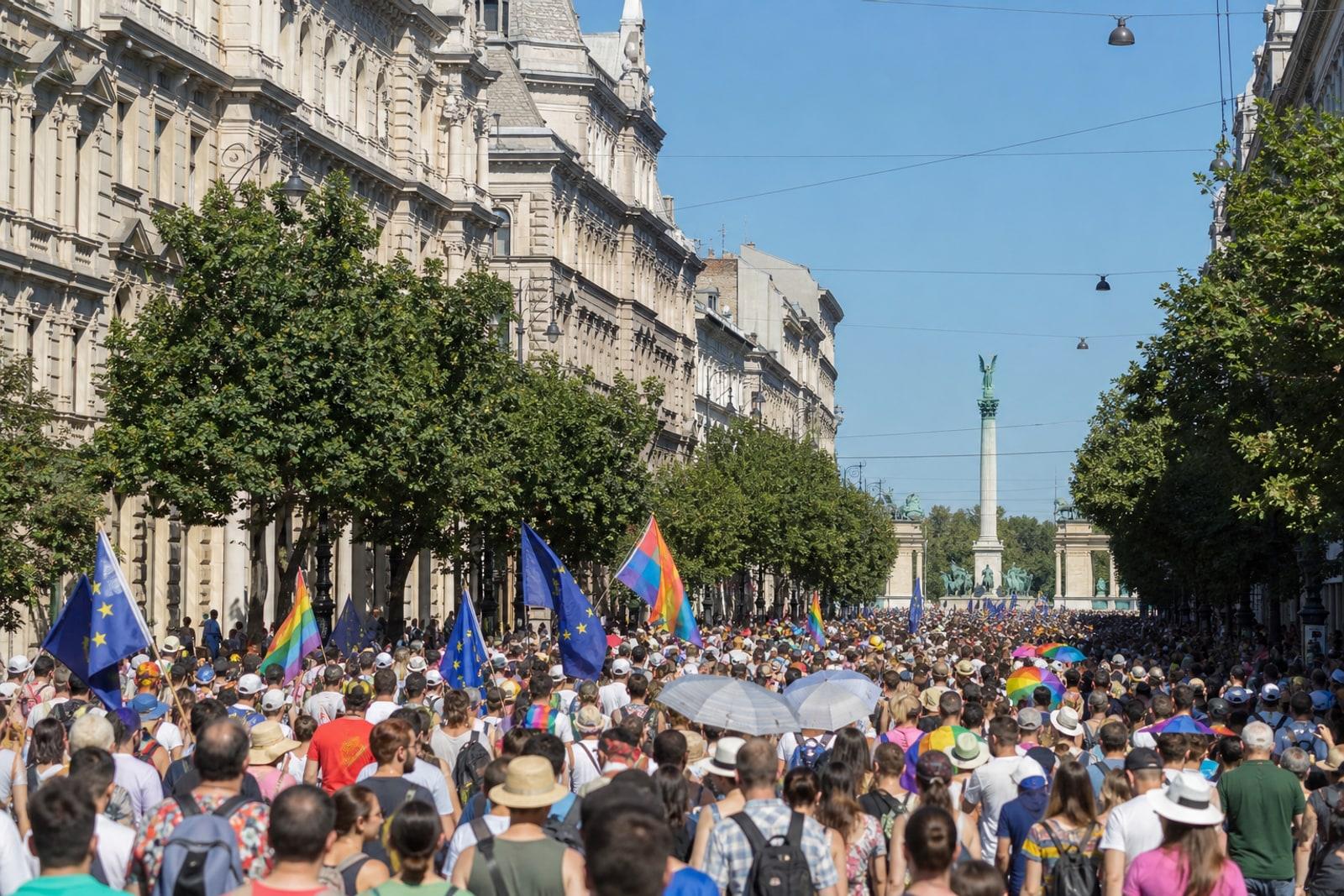
Tens of thousands of people marched through the heart of Budapest on Saturday for a Pride parade that, for the first time in a generation, carried no risk of a police ban — a celebration that doubled as a victory lap for Hungary's embattled LGBTQ community and for the European Union's claim that its fundamental-rights guarantees still bind every member state.
An AFP photographer at the scene estimated at least 100,000 participants streaming down Andrássy Avenue, the grand boulevard that has hosted the march for three decades. The turnout fell short of last year's record — when between 100,000 and 200,000 people defied an outright ban — but the mood had shifted from defiance to something closer to relief. This was the first Budapest Pride since Viktor Orban left office after 16 years in power.
A ban overturned at the ballot box and the bench
The reversal rests on two events that reshaped Hungarian politics within weeks of each other. On 12 April 2026, Orban's Fidesz party lost a parliamentary election to Peter Magyar's centre-right, pro-EU Tisza party, which won 138 of 199 seats on 53.6 percent of the vote against Fidesz's 37.8 percent, on a record turnout above 77 percent. Magyar, a former Fidesz insider turned chief rival, took office the following month.
Nine days after the vote, on 21 April, the Court of Justice of the European Union delivered its judgment in Commission v Hungary (C-769/22). Sitting as a Full Court of all 27 judges — a formation reserved for cases of exceptional importance — it found that Hungary's 2021 "child protection" law breached the Union's founding values, citing Article 2 of the Treaty on European Union and Article 1 of the Charter of Fundamental Rights on human dignity. The same legal architecture had been used in March 2025 to outlaw Pride.
The case drew an intervention without precedent in the bloc's history: 16 member states — among them Luxembourg — lined up behind the European Commission, the European Parliament joined as a party, and not one government sided with Budapest. For the new administration, the police decision came quickly. Organisers notified authorities at the end of May, and officers concluded there were no grounds to prohibit the assembly.
This is a landmark ruling making clear that Hungary's anti-LGBT law has no place in the European Union and should be repealed.
That assessment came from Lydia Gall, senior Europe and Central Asia researcher at Human Rights Watch, after the April judgment.
The mayor who called himself 'a proud defendant'
No figure embodies the year's turn more than Budapest Mayor Gergely Karácsony. When Orban's government banned the 2025 march, Karácsony declared it a municipal celebration that required no police permit, and the parade went ahead on 28 June 2025 with no participant arrested or fined.
For that, prosecutors charged him in January 2026 with organising an unlawful assembly in defiance of a prohibition order. He responded by calling himself "a proud defendant".
"It seems that in this country, this is the price you pay if you stand up for your freedom," Karácsony said after his indictment, according to the Associated Press. On 4 June 2026, the Budapest Chief Prosecutor's Office dropped the case, citing the European Court of Justice's ruling that the law underpinning the charge was incompatible with EU values.
What still hangs over the marchers
The celebration was not unqualified. The amendments that criminalised Pride participation and authorised police to deploy facial-recognition cameras against attendees remain formally on the statute book, repealed by neither parliament nor court. EUobserver reported that the surveillance apparatus built to deter marchers remains embedded in Hungarian law even as prosecutions have stopped. Other discriminatory measures have also survived the change of government, including:
- a 2020 ban on changing one's legal gender on official documents;
- restrictions confining adoption to married couples.
For many in the crowd, the direction of travel mattered more than the unfinished legal cleanup. "I think the situation is getting better and better, mainly because of the change in government," said Petra Toth, an 18-year-old marcher quoted by AFP.
Why Luxembourg is watching
For Luxembourg, the scene in Budapest is more than a distant culture-war headline. The Grand Duchy was one of the 16 governments that formally backed the Commission's case against Hungary — part of a years-long effort by Luxembourg ministers and MEPs to have the bloc defend LGBTQ rights as a matter of EU law rather than national preference. Luxembourg's foreign minister, Xavier Bettel, who served as prime minister from 2013 to 2023 and is one of the EU's few openly gay government leaders, has been among the most consistent voices for that stance.
The stakes, as Luxembourg has long argued, reach well beyond a single parade. The question the Budapest case poses is whether the rights written into the EU treaties still hold inside a member state whose government once set out to override them — a test of the bloc the Grand Duchy helped found. On Saturday, with the flags raised and the police lines absent, the answer looked, for now, like yes.
Frequently asked
- Was Budapest Pride 2026 legal?
- Yes. Organisers notified police at the end of May 2026 under Hungary's Assembly Act, and officers found no grounds to prohibit it — making it the first Budapest Pride to proceed without a government ban since the 2025 prohibition was imposed.
- Why was the ban lifted?
- Two reasons. Viktor Orban's Fidesz lost the 12 April 2026 election to the pro-EU Tisza party led by Peter Magyar, and on 21 April the EU Court of Justice ruled in Commission v Hungary (C-769/22) that Hungary's anti-LGBT 'child protection' law breached the Union's founding values.
- What was Luxembourg's role?
- Luxembourg was one of 16 EU member states that intervened in support of the European Commission in the Court of Justice case against Hungary, and Luxembourg's government and MEPs have been consistently vocal in the bloc's rule-of-law dispute with Budapest.
Sources(15)
- 1Hungarian Pride parade banWikipedia · en.wikipedia.org
- 2Tens of thousands in Hungary defy ban to march at Budapest PrideAl Jazeera · aljazeera.com
- 3Around 100,000 march in Budapest Pride event in defiance of Hungary's banNPR · npr.org
- 4Peter Magyar wins Hungary election, unseating Viktor Orban after 16 yearsAl Jazeera · aljazeera.com
- 5Hungary election 2026 results: Peter Magyar wins, Viktor Orban concedes landmark defeatCNN · cnn.com
- 6Commission v Hungary (C-769/22)Wikipedia · en.wikipedia.org
- 7Hungary: Top EU Court Rules Anti-LGBT Law UnlawfulHuman Rights Watch · hrw.org
- 8Judgment: C-769/22 Commission v HungaryCourt of Justice of the European Union (curia.europa.eu) · curia.europa.eu
- 9Hungary's anti-LGBTI law and EU values: the CJEU's landmark Article 2 TEU judgmentEuropean Parliament (EPRS) · epthinktank.eu
- 10Charges against Budapest mayor for organizing Pride march droppedWashington Blade · washingtonblade.com
- 11Hungary charges Budapest mayor for allowing banned pride marchAl Jazeera · aljazeera.com
- 12Budapest Pride 2026: Major road closures and public transport changes announced for SaturdayDaily News Hungary · dailynewshungary.com
- 13Budapest Pride to push for equality after reversed banAFP via France 24 / Yahoo News · yahoo.com
- 14Budapest free to celebrate Pride again, but Orban-surveillance machine still in placeEUobserver · euobserver.com
- 15Infringement ruling tests whether Magyar will put pro-EU commitments into practiceILGA-Europe · ilga-europe.org
Related by topic