Astrophysics
Physicists Read a Black Hole's 'Fingerprints' at the Point of No Return
Analysing the clearest gravitational-wave signal yet recorded, an international team says it has detected the imprint of a black hole's event horizon for the first time.
By Marc Weber · · 4 min read
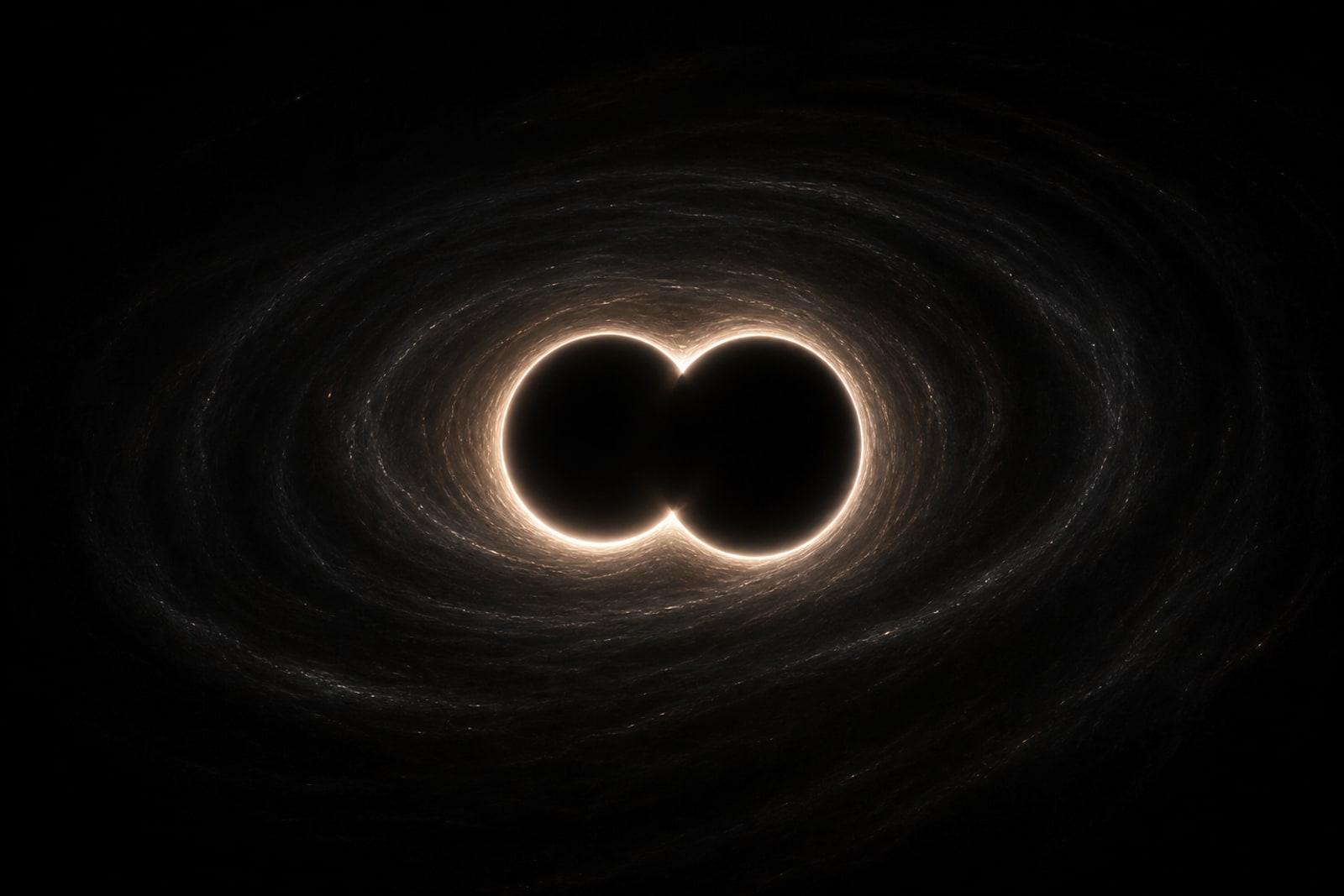
For the first time, physicists say they have read the faint signature of a black hole's event horizon — the boundary beyond which not even light can escape — in the ripples of spacetime flung outward when two black holes spiralled together and merged.
The signal, catalogued as GW250114, was picked up on 14 January 2025 by the twin detectors of the Laser Interferometer Gravitational-Wave Observatory (LIGO) in Washington state and Louisiana. It is the clearest gravitational-wave signal recorded to date — roughly three to four times louder than the first such detection a decade ago — and that exceptional clarity is what allowed researchers to probe a region that had until now stayed beyond reach. Their analysis was published in the journal Nature.
The work was carried out by a collaboration spanning the Australian National University's gravitational-wave centre, OzGrav, and Canada's Perimeter Institute for Theoretical Physics, with colleagues in the United States and Spain.
A 'direct wave' from the edge of the abyss
When two black holes collide, the violence of the merger sets the surrounding spacetime ringing like a struck bell. Most of that signal has been studied before. But buried within it is a small, previously poorly understood component the team calls the direct wave — gravitational radiation emanating from just outside the newly formed black hole's horizon.
By isolating that final burst, the scientists say they extracted information from closer to an event horizon than ever before. According to the study, the direct wave oscillates at close to twice the horizon's rotation frequency and then fades at a rate fixed by the horizon's surface gravity — a precise pattern that general relativity predicts and that the data appear to match. The researchers report evidence for the direct wave with a matched-filter signal-to-noise ratio of about 14 in LIGO's Hanford detector.
This black hole horizon concept normally appears in science fiction. But now we are really able to touch the region around the horizon with gravitational data.
That assessment came from Sizheng Ma of the Perimeter Institute, a lead author of the paper, who added of the result: "Sometimes I cannot believe this is really happening."
The whirlpool in spacetime
What the direct wave encodes is one of general relativity's stranger predictions: frame dragging. A spinning black hole does not simply sit in space; it drags the fabric of spacetime around with it, forcing everything nearby to rotate. In the innermost zone, known as the ergosphere, nothing can stay still.
Neil Lu, a PhD candidate at the Australian National University and a co-author, described the direct wave as radiation "that comes from right outside the event horizon, where everything that is falling into the black hole experiences frame dragging," likening the effect to water spinning in a whirlpool that forces objects to turn with it.
Maximiliano Isi, a gravitational-wave astrophysicist at Columbia University who was not involved in the study, offered a homelier image. "This is similar to pushing a glass into a table and twisting it, so that the tablecloth winds up around it," he told AFP. The cloth, in this analogy, is spacetime itself.
The measurement, the authors argue, amounts to the first direct read-out of frame dragging in a black hole's ergosphere — and a new way to study the physics of the near-horizon region, where gravity is at its most extreme.
Einstein, confirmed again — and a new way to test him
Black holes and frame dragging were both predicted by Albert Einstein's general theory of relativity, completed in 1915. A century on, the new measurements line up with what the theory says they should be, adding to a long run of experimental successes for the framework.
The significance, researchers say, is less about overturning Einstein than about opening a fresh observational channel. If the direct wave can be measured in future mergers, it gives physicists a new lever to test general relativity in the strongest gravitational fields known — and to hunt for any cracks where new physics might hide.
Outside experts urged the usual caution that accompanies a single landmark result. The Italian theoretical physicist Francesco Sannino called the analysis "compelling" and the findings "striking," while stressing that they will need independent verification before the community treats the detection as settled.
For now, the key claims of the work include:
- The event: GW250114, a binary black hole merger detected by LIGO on 14 January 2025 — the loudest gravitational-wave signal yet observed.
- The find: a "direct wave" carrying the imprint of the remnant black hole's event horizon, isolated for the first time.
- The physics: the wave's frequency tracks the horizon's spin (frame dragging) and its decay tracks the horizon's surface gravity.
- The verdict: the measured properties agree with general relativity, and offer a route to sharper future tests.
One detail is worth keeping straight amid the headlines: this is a gravitational-wave result, drawn from LIGO's listening to spacetime, not a new photograph from the Event Horizon Telescope. The two approaches are complementary — one images a black hole's silhouette, the other feels the tremors of a collision — but it was the tremor, this time, that carried the horizon's fingerprint.
Frequently asked
- What did scientists actually detect?
- By isolating a faint 'direct wave' within the gravitational-wave event GW250114, researchers detected an imprint of the remnant black hole's event horizon — including the twist of spacetime (frame dragging) and the horizon's surface gravity — for the first time.
- Was this done with the Event Horizon Telescope?
- No. The result comes from LIGO, which detects gravitational waves — ripples in spacetime — rather than from the Event Horizon Telescope, which captures radio images of black holes. The two methods are complementary.
- Does it prove Einstein right?
- The measured signal matches predictions of general relativity, adding to the theory's track record. Researchers frame it mainly as a new way to test Einstein in extreme gravity, and outside experts say it still needs independent verification.
Sources(7)
- 1'Fingerprints' of Black Hole's Event Horizon Detected for First TimeAsharq Al-Awsat (AFP) · english.aawsat.com
- 2'Fingerprints' of black hole's event horizon detected for first timeDawn (AFP) · dawn.com
- 3Binary black hole signal probes event horizon region for first timePhys.org · phys.org
- 4A 'direct wave' from colliding black holes reveals signature of a whirlpool in spacetimeThe Conversation · theconversation.com
- 5Scientists May Have Detected The First Signature of a Black Hole's Event HorizonScienceAlert · sciencealert.com
- 6GW250114 reveals black hole horizon signatures (preprint)arXiv:2510.01001 · arxiv.org
- 7GW250114 - WikipediaWikipedia · en.wikipedia.org
Related by topic