Colonial reckoning
Belgium opens its colonial Congo archives just as the world races for the DRC's minerals
An EU-funded push to digitise Tervuren's vast geological archive — and a rebuffed bid by a Gates- and Bezos-backed US firm — has turned Belgium's colonial paper trail into a strategic asset.
By Tom Schmit · · 4 min read
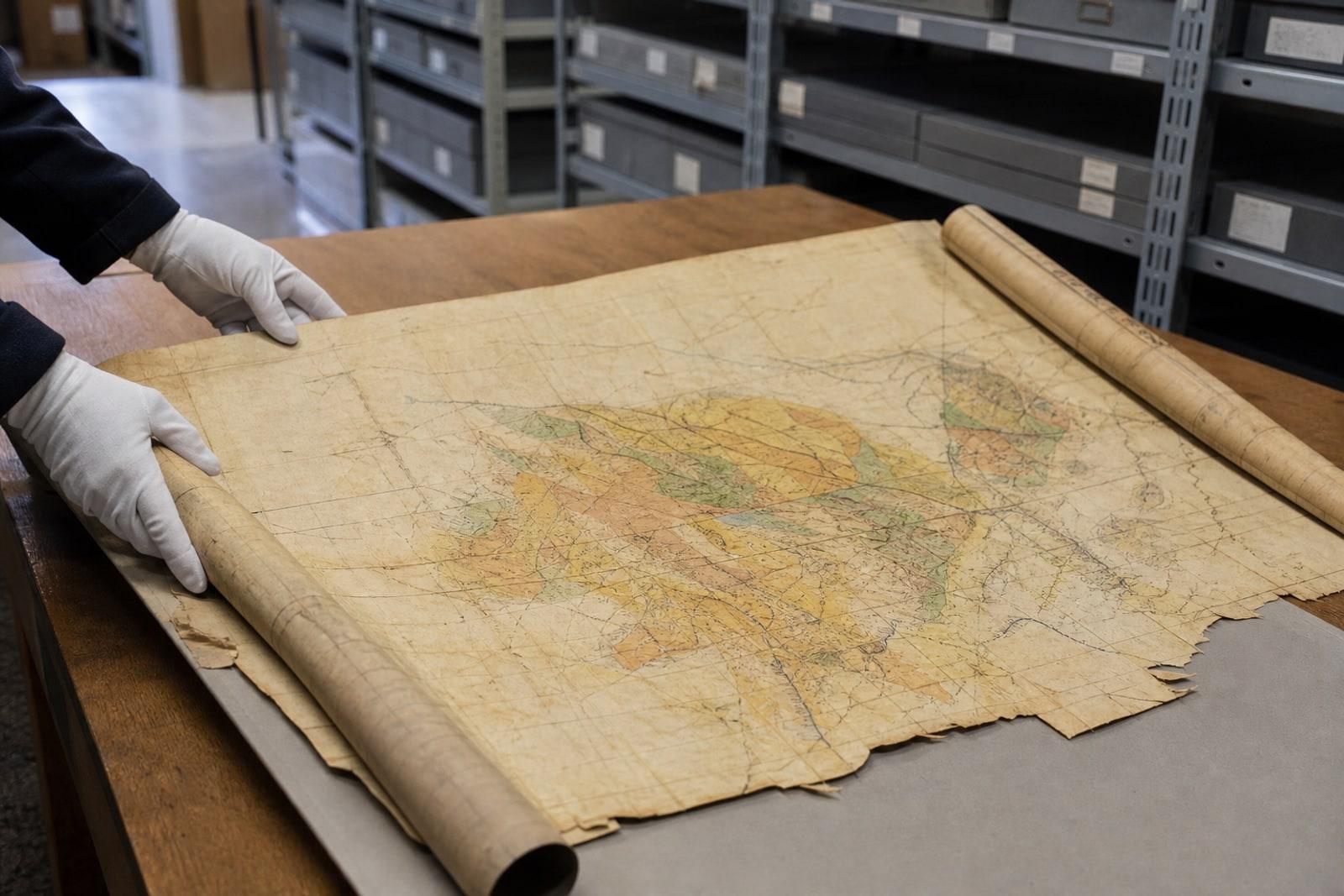
Belgium is opening up one of the most consequential paper trails of the colonial era. The AfricaMuseum in Tervuren, outside Brussels, has pledged to digitise its geological archive on the Democratic Republic of Congo — nearly 500 metres of shelving holding millions of century-old maps, surveys, drill logs and field notes — and make it publicly available within about five years, AFP reported on Friday. A further 500 metres of records inherited from former colonial mining companies sit in the State Archives in Brussels.
The timing is anything but academic. The documents chart how Congo's subsoil was mapped and exploited under Belgian rule between 1885 and 1960 — and Congolese officials believe they could point the way to undiscovered deposits of copper, cobalt, lithium and coltan, the raw materials of electric vehicles, renewable energy and modern defence systems. The DRC accounted for roughly 76 percent of the world's mined cobalt in 2024, according to the US Geological Survey, and is the world's second-largest copper producer. Its mines ministry estimates that around 90 percent of the country's mineral wealth remains untapped.
A museum archive becomes a strategic asset
What forced the issue was a bid from the private sector. KoBold Metals, a California exploration company backed by Bill Gates and Jeff Bezos that uses artificial intelligence to hunt for mineral deposits, signed agreements with the Congolese government in 2025 and offered to digitise the Tervuren archive itself. Kinshasa supported the idea; according to Belgian public broadcaster VRT, the Trump administration pressed Belgium through diplomatic channels to let the company in.
Brussels refused. "Belgium cannot grant exclusive access to a foreign company or private entity with which it does not have a contractual relationship," Belgian foreign ministry spokesperson Florinda Baleci told Reuters in March. The museum's director general, Bart Ouvry, was blunter about the principle at stake.
"We cannot delegate the management of collections to private companies; it would go against all scientific and institutional ethics."
Instead, the museum is running its own digitisation programme with significant EU funding and a European contractor, working with the DRC's National Geological Service as scientific partner. KoBold, for its part, has pressed ahead elsewhere, digitising some 170,000 pages of Congolese government mining records at a university in Lubumbashi. "This country needs more investment in exploration," the company's DRC director general, Benjamin Katabuka, told Reuters.
Kinshasa gets a seat at the table
The dispute has accelerated a broader settlement between the two capitals. On 9 June, DRC Mines Minister Louis Watum Kabamba met Belgian and EU officials in Brussels, where the sides agreed a joint roadmap for the digitisation and restitution of the records and set up a task force to steer the work with Congolese institutions. A Belgian government spokesperson said digital copies are already being sent to the relevant Congolese authorities gradually.
For Congolese researchers and officials, the stakes go beyond prospecting. The archives document the concession system through which colonial mining companies carved up Katanga's copperbelt and the profits that flowed to Brussels — a record of extraction that Kinshasa has long argued belongs, at least in copy, to the country it describes. The geological files are only one seam of a much larger body of evidence: Belgium's foreign ministry is transferring its so-called Africa archives — some 9.5 linear kilometres of public records of the colonisation of Congo, Rwanda and Burundi, from the Congo Free State through the Ministry of Colonies — to the State Archives, a process under way since 2016 under Belgium's archives law. Roughly 6.5 kilometres have been moved so far, and in total about 20 kilometres of colonisation-related records are scattered across more than 80 Belgian institutions.
Europe's minerals problem, in paper form
The scramble over the Tervuren shelves is a miniature of the wider contest for Congolese resources. China dominates the DRC's mining sector today, while Washington has been deepening its partnership with Kinshasa to loosen that grip. The European Union, meanwhile, has bound itself to targets it cannot meet without countries like the DRC: its Critical Raw Materials Act requires that by 2030 the bloc extract 10 percent, process 40 percent and recycle 25 percent of the strategic raw materials it consumes — and that no single third country supply more than 65 percent of any of them. Brussels signed a strategic raw-materials partnership with Kinshasa in October 2023 and is backing the Lobito rail corridor to carry Congolese and Zambian metals to the Atlantic.
Seen from that angle, the EU-funded digitisation is both restitution and industrial policy: the same files that document colonial-era exploitation may help Europe — and Congo — locate the minerals of the energy transition.
- The Tervuren geological archive spans about 500 metres of shelving; a similar volume of mining-company records is held at the State Archives in Brussels.
- Digitisation, EU-funded and publicly run, is expected to take up to five years, with copies flowing to Congolese authorities as work proceeds.
- The DRC produced about 76 percent of the world's mined cobalt and is the second-largest copper producer, per the USGS.
Whether the maps yield new mines is, in the end, a question for geologists. What has already changed is who gets to read them: after six decades in which the record of Congo's subsoil sat in Belgian custody, the DRC is — page by scanned page — getting the archive of its own ground back.
Frequently asked
- Which Belgian colonial archives are being opened?
- The AfricaMuseum in Tervuren is digitising its ~500-metre geological archive on the Congo (1885–1960) for public release within about five years; the State Archives hold a further ~500 metres of former mining-company records, and the foreign ministry is transferring its 9.5-kilometre 'Africa archives' of colonial administration files to the State Archives.
- Why do the archives matter for critical minerals?
- The colonial-era surveys, maps and drill logs record how Congo's subsoil was mapped and exploited. Congolese officials believe they could reveal undiscovered deposits of copper, cobalt, lithium and coltan — key inputs for electric vehicles, renewables and defence — in a country whose mines ministry says about 90% of its mineral wealth is untapped.
- What was the dispute with KoBold Metals?
- KoBold Metals, a US exploration firm backed by Bill Gates and Jeff Bezos, offered to digitise the Tervuren archive after signing agreements with the DRC in 2025. Belgium refused exclusive private access, citing scientific ethics and the public status of the records, and opted for an EU-funded programme with the DRC's National Geological Service instead.
- What did Belgium and the DRC agree in June 2026?
- At a 9 June 2026 meeting in Brussels, DRC Mines Minister Louis Watum Kabamba and Belgian and EU officials agreed a joint roadmap for the digitisation and restitution of the geological records and created a task force to coordinate the work, with digital copies being sent to Congolese authorities progressively.
Sources(12)
- 1Belgium opens up Congo archives amid global minerals raceAFP (via Yahoo Finance) · finance.yahoo.com
- 2Belgian museum, US mining company at odds over colonial-era Congo archiveReuters (via WHBL) · whbl.com
- 3Belgian museum, US mining company at odds over colonial-era Congo archiveReuters (via Mining Weekly) · miningweekly.com
- 4AfricaMuseum refuses to release Congo geological archive to US mining company, despite pressure from President TrumpVRT NWS · vrt.be
- 5Congo, Belgium agree on transfer of colonial-era geological recordsMINING.COM · mining.com
- 6The Stakes Behind Congo's Push to Recover Its Geological ArchivesEcofin Agency · ecofinagency.com
- 7Belgium denies private access to Congo colonial mining archivesBelga News Agency · belganewsagency.eu
- 8Africa archivesFPS Foreign Affairs, Belgium · diplomatie.belgium.be
- 9Archives related to the colonial eraState Archives of Belgium · arch.be
- 10European Critical Raw Materials ActEuropean Commission · commission.europa.eu
- 11Navigating Critical Mineral Supply Chains: the EU's Partnerships with the DRC and ZambiaAfrica Policy Research Institute · afripoli.org
- 12Cobalt — Mineral Commodity Summaries 2025U.S. Geological Survey · pubs.usgs.gov
Related by topic