Space economy
Asteroid Day returns to Luxembourg as its space-resources bet turns ten
A veteran NASA spacewalker headlined the festival in Luxembourg City this weekend, as the Grand Duchy weighs a decade of its pioneering wager on asteroid mining and a space economy.
By Marc Weber · · 4 min read
A NASA astronaut who logged more than 32 hours of spacewalks outside the International Space Station was among the guests as Asteroid Day, the United Nations-backed awareness campaign run from Luxembourg, returned to the capital this weekend — a fixture that doubles as a showcase for the Grand Duchy's decade-old wager on a space economy.
The Asteroid Day Festival ran on 26 and 27 June at the Cercle Cité in central Luxembourg City, with a public day of talks, workshops, exhibitions and planetary-defence demonstrations open free of charge, according to the organising Asteroid Foundation and the venue's programme. Headlining a line-up of space veterans were retired NASA astronaut Mike Foreman, former Canadian astronaut Julie Payette and Romanian cosmonaut Dumitru-Dorin Prunariu.
A veteran spacewalker among the guests
Foreman, a retired US Navy captain selected by NASA in 1998, flew two space shuttle missions — STS-123 aboard Endeavour in March 2008 and STS-129 aboard Atlantis in November 2009 — and carried out five spacewalks totalling 32 hours and 19 minutes, according to NASA. He spent more than 26 days in orbit and accumulated over 7,000 flight hours in some 50 types of aircraft before leaving the agency in 2015. When he retired, NASA's then chief astronaut Chris Cassidy said he was "a great American who has served our nation for 35 years."
The festival opened on the Friday evening with a live trivia session and an "Astronomer for a Night" stargazing experience led by the Italian astronomer Gianluca Masi. The Saturday programme ran from 10:00 to 18:00 with hands-on workshops, robotics and Mars-rover demonstrations, a temporary planetarium and virtual-reality stations tied to the European Space Agency's Hera planetary-defence mission. Entry was free but capped, with selected sessions live-streamed.
Asteroid Day was co-founded in 2014 by the Queen guitarist and astrophysicist Brian May, the Apollo 9 astronaut Rusty Schweickart, the filmmaker Grig Richters and the B612 Foundation president Danica Remy. The UN General Assembly designated 30 June as International Asteroid Day in December 2016, marking the anniversary of the 1908 Tunguska impact in Siberia. Luxembourg has hosted the campaign's programming for years, cementing it as one of the country's signature contributions to science diplomacy.
Ten years of betting on space resources
The festival arrives as Luxembourg takes stock of a bet placed a decade ago. In 2016 the Ministry of the Economy launched the SpaceResources.lu initiative, and with the law of 20 July 2017 — passed in parliament by 55 votes to two and in force from 1 August that year — Luxembourg became the first country in Europe and the second in the world, after the United States, to give companies legal title to resources they extract from asteroids and other celestial bodies, according to SpaceNews and the government.
That framework was meant to lure space-mining ventures and diversify an economy long reliant on finance and steel. The speculative asteroid-mining start-ups it first attracted have since pivoted or faded, but Luxembourg has steered the agenda toward research, infrastructure and standards. In May, Space Resources Week 2026 marked the tenth anniversary of the SpaceResources.lu initiative and the fifth of the European Space Resources Innovation Centre (ESRIC), drawing more than 490 registered participants from 35 countries — its largest edition yet.
"Space Resources Week fully embodies Luxembourg's ambition to position itself at the forefront of a pioneering and sustainable space sector," said Lex Delles, the Minister of the Economy.
The sector a decade on
The wager has built an ecosystem rather than a gold rush. Luxembourg Trade & Invest counts more than 80 companies and research labs in the sector; consultancy Deloitte puts the figure at over 60 firms employing around 1,000 people. Officials say space's contribution to GDP is among the highest ratios in Europe. The Luxembourg Space Agency, created in 2018, is deliberately business-focused rather than research-driven, channelling money through the national LuxIMPULSE programme and a dedicated Fit 4 Start track and brokering access to ESA and EU programmes.
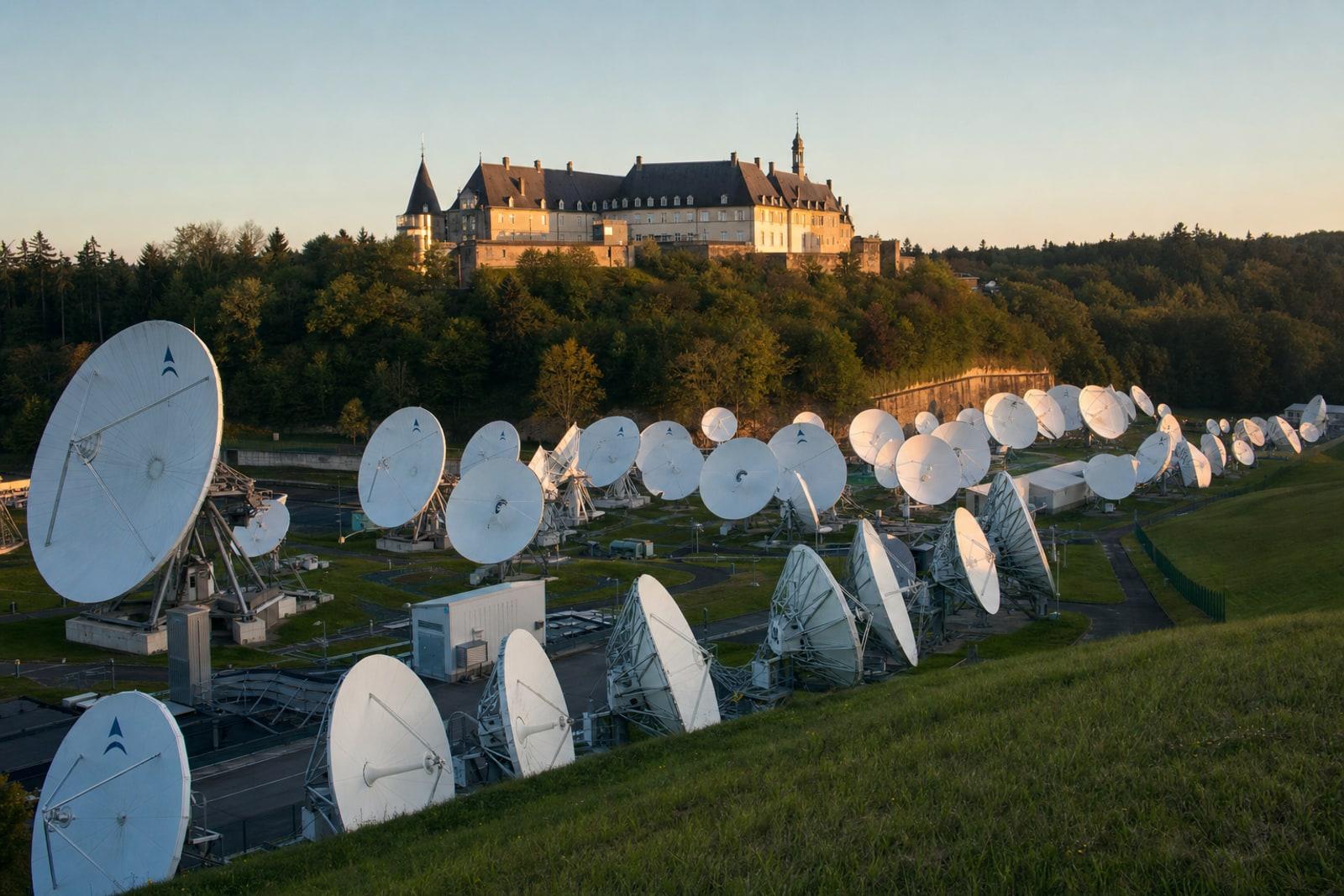
The anchor remains SES, the satellite operator founded in 1985 and headquartered at the Château de Betzdorf, whose hillside teleport bristles with around 100 white dishes. In July 2025 SES completed its acquisition of Intelsat, making it the world's largest combined geostationary and medium-Earth-orbit operator, with roughly 90 satellites in geostationary orbit and about 120 across both. ESRIC, meanwhile, runs what it bills as the world's first incubation programme dedicated entirely to space-resources use, and partners with ESA and the Luxembourg Institute of Science and Technology.
The numbers underline both ambition and exposure: a small state has concentrated an unusually large slice of output in a single, capital-intensive frontier. ESRIC's director, Kathryn Hadler, framed the appeal in plainer terms after May's gathering.
"We were delighted once again to bring the global space resources community to Luxembourg," she said.
For the families filing through the Cercle Cité this weekend, the draw was the astronauts and the rovers. For the government, the festival is a reminder that a bet made a decade ago — equal parts science, diplomacy and economic diversification — still has to pay off.
Frequently asked
- When and where was Asteroid Day 2026 held in Luxembourg?
- The Asteroid Day Festival took place on 26 and 27 June 2026 at the Cercle Cité in central Luxembourg City, with free public admission and registration required.
- Which NASA astronaut attended?
- Retired NASA astronaut and former US Navy captain Mike Foreman, who flew the STS-123 and STS-129 shuttle missions and carried out five spacewalks, was among the featured guests, alongside Canada's Julie Payette and Romania's Dumitru-Dorin Prunariu.
- What is Luxembourg's space-resources law?
- The law of 20 July 2017 made Luxembourg the first country in Europe and the second worldwide to give companies legal rights to resources they extract from asteroids and other celestial bodies, building on the 2016 SpaceResources.lu initiative.
- How big is Luxembourg's space sector today?
- Estimates range from over 60 to more than 80 companies and research labs employing around 1,000 people, with a GDP share among the highest in Europe; SES of Betzdorf is its anchor and the world's largest combined GEO/MEO satellite operator.
Sources(11)
- 1Asteroid Day LuxembourgAsteroid Foundation · asteroidfoundation.org
- 2Asteroid Day 2026Chronicle.lu · chronicle.lu
- 3Le Festival Asteroid Day fait décoller Luxembourg vers les étoilesLe Quotidien · lequotidien.lu
- 4Space Resources Week 2026 Concludes: Celebrating a Decade of Leadership and InnovationThe Luxembourg Government · gouvernement.lu
- 5Luxembourg adopts space resources lawSpaceNews · spacenews.com
- 6Veteran NASA Astronaut and Spacewalker Michael Foreman Retires From NASANASA · nasa.gov
- 7Michael Foreman (astronaut)Wikipedia · en.wikipedia.org
- 8Asteroid DayWikipedia · en.wikipedia.org
- 9Space — Discover Luxembourg's business sectorsLuxembourg Trade & Invest · luxembourgtradeandinvest.com
- 10Our HeadquartersSES · ses.com
- 11SES (company)Wikipedia · en.wikipedia.org
Related by topic